This lesson will help you understand the basic principles behind pharmacokinetics and give you some dentistry relevant examples to help put it into context.
This lesson will help you understand the basic principles behind pharmacokinetics and give you some dentistry relevant examples to help put it into context.
What is pharmacokinetics?
In simple terms pharmacokinetics is thought of as what the body does to the drug.
This encompasses absorption, distribution, metabolism and excretion– also known as ADME.
“Elimination” is also used occasionally. Technically metabolism + excretion = elimination.
Why is it important?
Pharmacokinetics helps us understand many properties of the drug we are investigating – a few examples are:
How quickly a drug will work.
Where the drug is primarily distributed.
Quantities to use when dosing a drug.
Any metabolites that are produced when the drug is broken down. Some for these are active:Diazepam (used for anxiety) is broken down into temazepam and oxazepam, both of which are active (and are used as drugs in their own right).
How the dose of drug may need to be altered to prevent toxicity in some cases of liver or renal impairment.
How are drugs administered?
Drugs can be administered in many ways:
Orally
Via injection – e.g. intravenously (IV), intramuscularly (IM), subcutaneously (SC) etc
Transdermally through a patch
Inhaled
Nasally via a spray
Sublingually
Rectally via a suppository
Vaginally via a pessary
You may also see other terms used, such as enteral administration (via the gastrointestinal tract), and parenteral administration (any route other than the gastrointestinal tract)
To keep this lesson simple, we will only consider oral and IV routes of administration when talking about pharmacokinetics.
A.D.M.E
Absorption
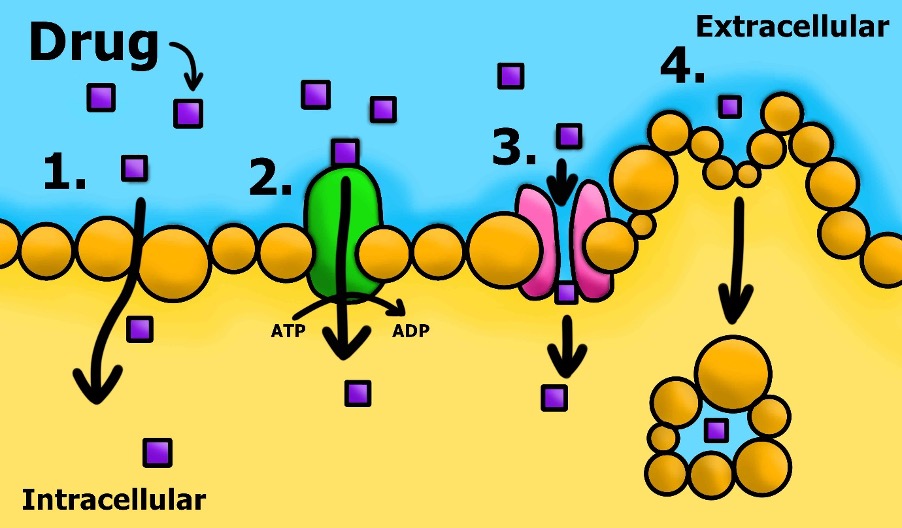
How are drugs absorbed from the GI tract?
Four main routes:
Passive diffusion through the cell membrane
Active transport
Facilitated passive diffusion via small pores
Pinocytosis – where a drug is engulphed and brought into the cell
Factors that influence absorption from the GI tract:
Some factors may affect absorption, these include:
Particle size – large molecules are often not absorbed
Chemical breakdown – e.g. insulin is broken down by the stomach acid
Concentration – the higher the concentration, the more drug that is absorbed (usually!)
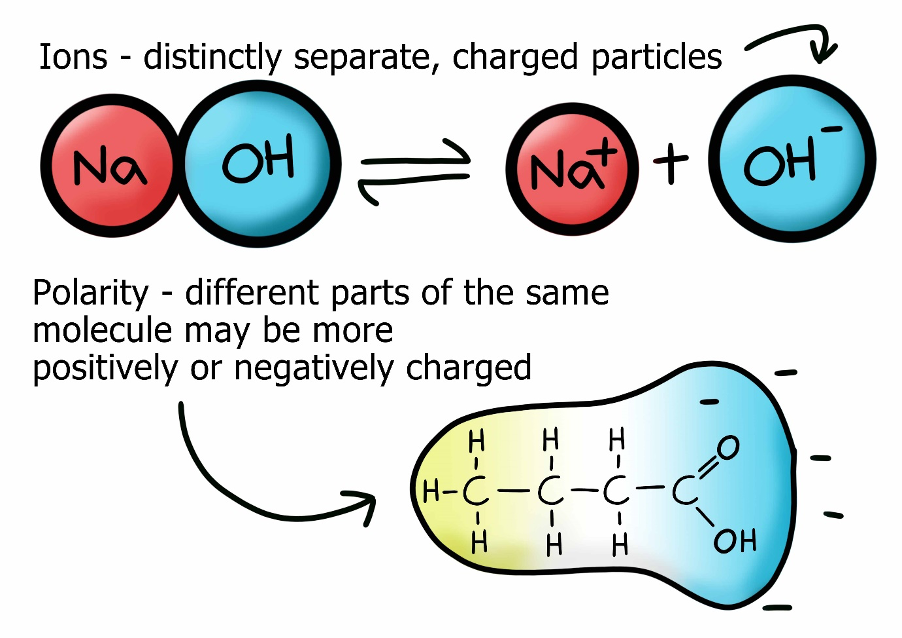
Ionisation – ionised particles cannot diffuse across membranes – this plays a part in the mechanism of action for local anaesthetics
Solubility – drugs that are more polar (see below) are less readily absorbed through the lipid bilayer of the cell membrane
Physical state of the drug – e.g. an oral suspension is absorbed more quickly than a modified release tablet
The effect of first pass metabolism (we will discuss this later)
Presence/absence of food – for example penicillin must be taken on an empty stomach as the presence of food decreases absorption.
Health of GI tract.
Polarity vs Ionisation
First Pass Metabolism
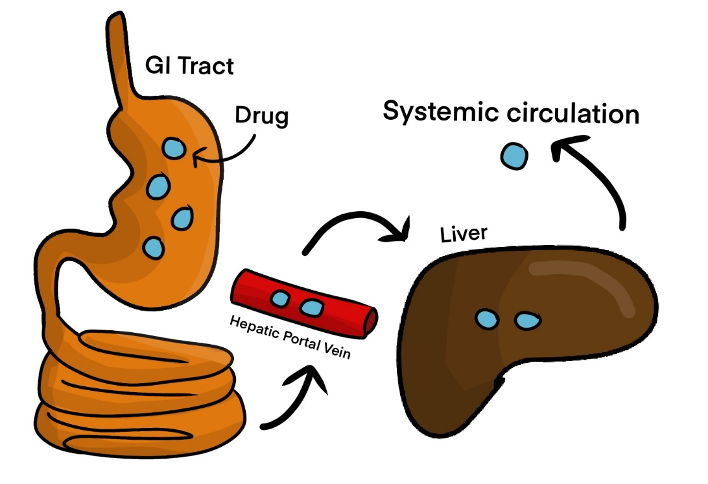
When a drug is absorbed from the GI tract it enters the bloodstream. However, it is not immediately available to the systemic circulation.
It must first travel through the hepatic portal vein and pass through the liver where it is filtered and exposed to hepatic enzymes which may metabolise it (we will discuss these in more detail later). This is known as “first pass metabolism” and is a way of the body defending itself against anything nasty that we’ve ingested.
Once the drug has passed through the liver it then reaches the systemic circulation and this is where the concentration can be measured in the blood. This concentration also relates to the therapeutic window which we discussed in the “Introduction To Pharmacology” lesson.
Some drugs are extensively metabolised during this process and this can decrease the bioavailability of the drug (which we will now discuss).
Route of drug after oral administration:
What is Bioavailability (F)?
Bioavailability: This is referred to as (F)or the Fraction of drug that is bioavailable. This is the percentage of drug that reaches the systemic circulation when a drug is administered. Normally bioavailability is referenced when discussing drugs administered orally, but it can relate to drugs administered by other methods – such as transdermally.
Bioavailability varies between drugs and may be 100%, or it could be much less. Some drugs may be poorly absorbed, meaning a large dose may need to be given orally for only a small percentage to actually reach the blood stream.
When a drug is given IV it is 100% bioavailable. This is because the entire dose is injected directly into the bloodstream, and therefore bypasses the factors listed above (e.g. poor absorption or extensive first pass metabolism).
How do we calculate the bioavailability (F)?
The equation for bioavailability is: (1)
Don’t worry, this equation looks complicated, but we will break it down:
We already know F is bioavailability.
AUC means “area under the curve”.
Dose is the amount of drug given via each method of administration. For our example we will assume we gave the same amount of drug for each method (IV and oral).
Now let’s explain the equation with a graph:
On the y axis is the concentration of the drug in the plasma and along the x axis is time. So, this graph shows the amount of drug in the plasma over time.
For the IV drug (injected directly into the systemic circulation), the concentration starts at the highest point, and over time decreases as the drug is eliminated (remember, elimination means metabolism and excretion).
For the oral drug the concentration in the blood gradually increases as it’s absorbed, peaks, then gradually decreases as it’s eliminated.
The area under the curve (AUC) for each line equals the total amount of drug present in the systemic circulation for each administration
The application of the equation:
Now we just need to apply the equation:
Say for example we administered 500mg of drug in both situations.
In the IV curve, the AUC will equal 500mg because the bioavailability is 100%.
In the oral curve, the AUC may only equal 400mg – this shows us that only 80% of the drug was absorbed; therefore, the bioavailability (F) is 80%, or 0.8.
If we administer different quantities of drug, we just need to add that information into the equation, but the principle is the same.
In summary the equation for bioavailability (F) is:
For our example: (400/500) x (500/500) = 0.8 x 1 = 0.8, Therefore, F = 0.8
Remember, bioavailability only relates to the drug that reaches the systemic circulation during absorption. The elimination characteristics of the drug are described by its half-life (t½). We will cover this at the end of the lesson.
Example question:
A rat was given 60mg of drug via IV injection. The plasma concentration was tested every 30mins and plotted on a graph. The AUC for the IV curve was 60mg. 130mg of the same drug was given to a different rat via an oral solution. The plasma concentration was tested every 30mins and the AUC was 30mg. What is the bioavailability of the drug when given in oral solution?
Tip: You have been given lots of excess information, read through carefully and identify what is important for the equation.
Answer at the end of the lesson.
Distribution
This is concerned with the distribution of the drug amongst the tissues in the body, after absorption.
Things to consider:
We can only measure the concentration of the drug in the blood plasma.
We do this by taking a sample of blood and measuring the amount of drug in this known volume.
Concentration of drug in blood = mass of drug/volume or C = M/V
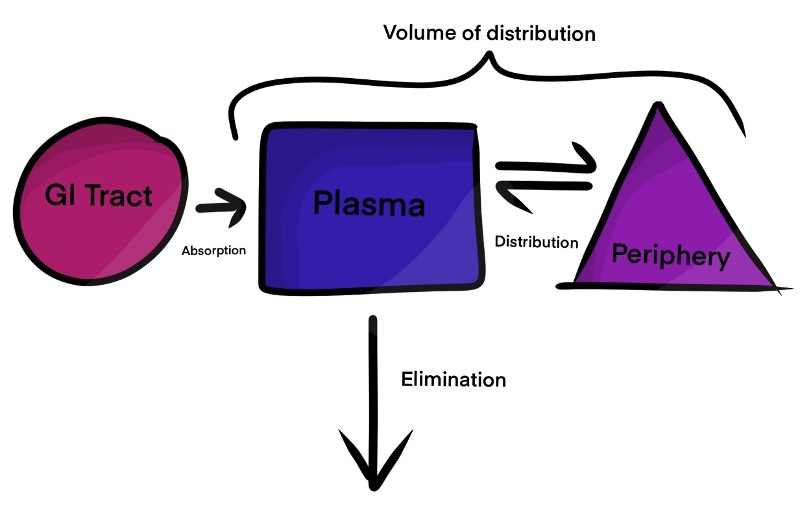
However, we recognise that the body is made up of more than just blood – there are various other areas in the periphery the drug could diffuse into – for example:
Intracellular water
Adipose tissues (fat)
Interstitial water
These other areas are known as compartments.
Diagram schematic of distribution
Volume of Distribution (VD)
In many cases the concentration of the drug in the blood might be lower than expected - because some of the drug has diffused into compartments, and we can only measure what is in the blood plasma.
This is called the apparent volume of distribution (VD).
Apparent VD
Drugs with a low VD are primarily distributed in the blood, so may be more hydrophilic.
Drugs with a high VD have diffused more into the surrounding tissues and so may be more lipophilic.
Drugs with a high VD may also take longer to eliminate (have a longer half-life – t½) as they can only be eliminated when in the blood stream – more of the drug is hiding in the tissues when the VD is high. The drug can be slow to diffuse out of the tissues and back into the blood.
What happens to the drug when it’s in the circulation?
Bound to tissues
Adsorbed onto bone
Partitioned into adipose tissue
Boundtoplasmaproteins e.g. albumin
It is important to note that it is only the unbound drug that can exert an effect – each of the above would render the drug inactive.
Drugs may compete for the same protein – i.e. Two drugs administered at the same time may compete to bind to the same plasma protein. One of them will have a higher affinity for the protein and will displace the other. This means that there will be more of the other drug free in the plasma to exert its effects.
Clinically, there are very few plasma protein displacement interactions that are significant. This is thought to be because the displaced drug tends to redistribute throughout the body.
Plasma Protein Drug Binding
Metabolism
This is the processing and breakdown of the drug by the body.
Not all drugs are fully metabolised, and often a percentage of a drug is excreted unchanged.
Example: Up to 70% of amoxicillin is excreted unchanged in urine during the first 6 hours after administration of one 500mg dose. (2)
What are the main methods of metabolism?
A large percentage of drugs are metabolised by the liver.
Example: Amide local anaesthetics, such as Lidocaine.
Some drugs can be metabolised in the blood.
Example: Ester local anaesthetics, such as benzocaine. These are metabolised by plasma esterases.
The kidneys also contain enzymes and often play a part in phase II metabolism – we will discuss this later.
There are some other minor methods of metabolism such as enzymes present in the lungs.
How does the liver metabolise drugs?
Cytochrome P450 Enzymes
Within the liver, are an important group of enzymes called cytochrome P450 (CYP450). They’re found in the hepatic smooth endoplasmic reticulum within the hepatocytes.
The family of enzymes is broken down into subcategories – important examples are CYP450 3A4, 2D6, 2C19 and 2C9.
These enzymes can also be inhibited or induced by drugs and can be involved in drug interactions.
Dentally relevant examples (not by any means exhaustive): (3)
Inducers CYP450 3A4:
Phenytoin (epilepsy)
Carbamazepine (epilepsy, trigeminal neuralgia)
Rifampicin (TB)
St John’s Wort (an over-the-counter supplement)
Inhibitors CYP450 3A4:
Grapefruit juice
Clarithromycin (antibiotic)
Erythromycin (antibiotic)
Fluconazole (antifungal)
Drugs metabolised by CYP450 3A4:
Clarithromycin (antibiotic)
Erythromycin (antibiotic)
Warfarin (anticoagulant)
Some statins e.g. Simvastatin (to treat high cholesterol)
Inducers CYP450 2D6:
Rifampicin (TB)
Inhibitors CYP450 2D6:
Many selective serotonin reuptake inhibitors – e.g. citalopram, fluoxetine, sertraline (anxiety and depression)
Drugs metabolised by CYP450 2D6:
Codeine (opioid painkiller)
Inducers CYP450 2C19:
Rifampicin (TB)
Carbamazepine (epilepsy, trigeminal neuralgia)
Inhibitors CYP450 2C19:
Lansoprazole, omeprazole (reflex and heartburn)
Drugs metabolised by CYP450 2C19:
Warfarin (anticoagulant)
Diazepam (sedative, anxiolytic)
Phenytoin (epilepsy)
Inducers CYP450 2C9:
Rifampicin (TB)
Carbamazepine (epilepsy, trigeminal neuralgia)
Inhibitors CYP450 2C9:
Miconazole (antifungal)
Fluconazole (antifungal)
Drugs metabolised by CYP450 2C9:
Warfarin (anticoagulant)
Non-steroidal anti-inflammatories
Clopidogrel (antiplatelet)
Genetical variations
Genetic variations can lead to altered CYP450 polymorphisms and so altered metabolism of drugs.
An example of this is a variation in the CYP450 2D6 enzyme. Some people may possess a variation of this enzyme that does not work as efficiently (poor metabolisers). Others have a variation which results in the enzyme working much more quickly (rapid or ultra-rapid metabolisers).
Codeine is a prodrug which means it must be metabolised into its active form (morphine) to work. This occurs via the CYP450 2D6 enzyme. Poor metabolisers may not metabolise codeine effectively and may be resistant to its effects. Ultra-rapid metabolisers may be the opposite and experience large conversion to morphine rendering them sensitive to the drug.
Phases of metabolism:
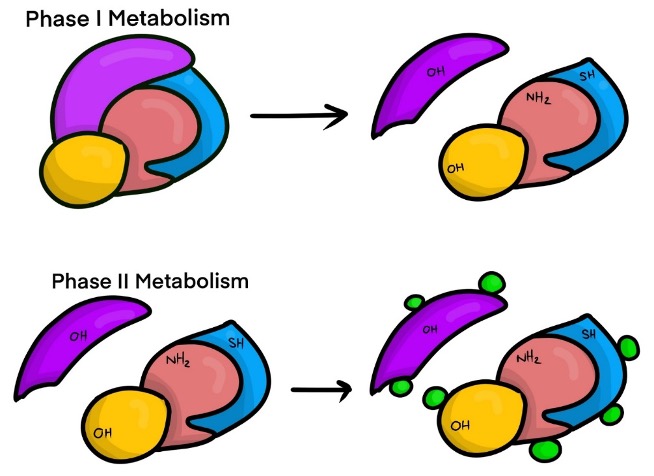
Phase I metabolism: Oxidation, reduction or hydrolysis
Occurs in the liver
Usually involves CYP450
Often involves breaking down chemical bonds
Makes the molecule more polar. We covered polarity above, drugs that are more polar are more water soluble and so are more easily excreted in the urine.
Often creates active metabolites
Phase II metabolism: Conjugation, glucuronidation, acetylation etc
Occurs in the liver and kidneys
Involves other enzymes to CYP450 (various transferases)
Often involves the addition of polar groups
Often deactivates metabolites
Excretion
This involves the removal of the drug from the body.
It usually relates to the kidneys; but can also involve the lungs and liver (excretion via exhalation, or via bile into faeces).
What is Clearance (CL)?
This is the rate at which the organ involved removes the drug.
It can refer to total clearance (CLTotal), or as clearance of the individual organ e.g. CLLiver, CLRenal
Excretion in the kidney
Occurs via three main methods: (4)
Glomerularfiltration – filtration of soluble drugs free in the plasma.
Activesecretion of drugs in proximal tubules – the drug is actively pumped into the urine, against its concentration gradient.
Note: Some drugs may compete for the same transporter.
Passivereabsorption from the distal tubule – The drug passively diffuses back into the plasma from the distal tubule.
A high urine flow rate may lead to larger clearance of the drug and a low flow rate (e.g. in dehydration) may lead to lower clearance.
Acidity of the urine may also play a part, with drugs becoming ionised and trapped in the distal tubule – this is the same principle that occurs in neurons in the mechanism of action for local anaesthetics (LA). We will cover this in the LA lesson.
What is half-life (t½)?
Half-life is the time it takes for the drug concentration to reduce by half. This depends on both metabolism and excretion, and so each drug will have a different half-life.
Drugs with short half-lives tend to wear off more quickly and may require more frequent dosing. Drugs with a long half-life can sit in the body for extended periods after the medication has been stopped; meaning they can still interact with other prescribed medication. This is why it is important to have a full medical history, including recently stopped medications.
A Graph to show the half life of a drug
On this graph we can see that it takes one hour for the drug concentration in the plasma to decrease by half. Therefore, the half-life is 1 hour.
A graph to show drugs with different half lives
On this graph we can compare drugs with different half-lives and how that relates to the frequency of dosing. The drug with the short life is eliminated quickly and we must give frequent doses to keep the concentration within the therapeutic window. The drug with the long half-life takes longer to be eliminated and so the concentration stays within the therapeutic window for longer. For this drug we do not need to dose as frequently.
Examples of this in dentistry are the antibiotics penicillin (phenoxymethylpenicillin is the full name) and doxycycline. Penicillin has a short half-life of approximately 45mins and so is usually dosed 4 times a day. (5) Doxycycline has a comparatively long half-life of 16-22hrs and so is often dosed once or twice a day. (6)
How does pharmacokinetics relate to treating patients?
When prescribing you need to be aware of the properties of the drug you are using and how they may affect your patient. Certain medical conditions can influence how a patient’s body processes a drug, and interactions between medications can be important. Understanding the pharmacokinetic principles will allow you to make informed decisions about how to modify your prescribing or find alternative drugs when necessary.
Relevant examples (not exhaustive): (7)
Absorption:
Penicillin should be taken on an empty stomach but amoxicillin and co-amoxiclav can be taken with or without food. Penicillin is not absorbed efficiently in the presence of food, whereas amoxicillin is not affected.
Metabolism:
Miconazole increases conc. warfarin
Metronidazole increase conc. warfarin
Erythromycin increases conc. warfarin
Erythromycin increases conc. simvastatin
Clarithromycin increases conc. warfarin
Clarithromycin increases conc. simvastatin
Fluconazole increases conc. warfarin
Fluconazole increases conc. simvastatin
Codeine + hepatic impairment: Manufacturer advises dose reduction in mild to moderate impairment.
Answer to bioavailability question:
This question was designed to be wordy to give excess information. It might help to highlight or jot down the key information when reading.
F = (30/60) x (60/130) = 0.5 x 0.46 = 0.23, Therefore, F = 0.23
Conclusion
This lesson has covered the basic principles for pharmacokinetics such as ADME, as well as highlighting some of the relevance in the dental clinic. The details are for context so don’t get hung up on them and always remember to check the BNF for relevant interactions.
If you ever want to know more about the pharmacokinetic properties of a drug, visit the EMC’s website and use the search function to find the drug. View the SmPC (summary of product characteristics) and scroll to the “pharmacokinetic properties” section.
References
Johanson G. 1.08 - Modeling of Disposition. In: McQueen CA, editor. Comprehensive Toxicology (Second Edition) Oxford: Elsevier; 2010. p. 153–77.
Amoxicillin 500 mg Capsules BP - Summary of Product Characteristics (SmPC) - (emc) [Internet]. [cited 2020 May 22]. Available
CYTOCHROME P450 DRUG INTERACTION TABLE - Drug Interactions [Internet]. [cited 2020 May 22]. Available
Ritter, J.M. Flower, R. Henderson, G. Loke, Y.K. MacEwan, D. Rang, H. P. Rang and Dale's pharmacology. 9th Edinburgh: Elsevier/Churchill Livingstone. 2020.
Phenoxymethylpenicillin 250mg Film-coated Tablets - Summary of Product Characteristics (SmPC) - (emc) [Internet]. [cited 2020 May 22]. Available
Doxycycline 100mg Capsules - Summary of Product Characteristics (SmPC) - (emc) [Internet]. [cited 2020 May 22]. Available
Joint Formulary Committee. British National Formulary(online) London: BMJ Group and Pharmaceutical Press. Available
Brenner GM, Stevens CW. Brenner and Stevens’ Pharmacology, Fifth Edition - ClinicalKey Student [Internet]. [cited 2020 May 22]. Available