This lesson will cover the fundamentals of genetics relevant to dentistry, ie. physiology of inheritance and mutations. This will allow you to apply this when discussed in later lessons in relation to development abnormalities or diseases.
A gene is a length of DNA that codes for one or more polypeptides through its sequence of nucleotide bases and is a unit of heredity. It is a triplet code which means that a sequence of three nucleotide bases codes for an amino acid and several codes may be used to form the same amino acid.
Transcription is the creation of a single stranded mRNA copy of the DNA coding strand and is the first stage of protein synthesis.

Translation is the assembly of polypeptides at ribosomes. It is the second stage of protein synthesis when the amino acids are assembled into a polypeptide, taking place in the cytoplasm at the ribosomes. The sequence of amino acids in the polypeptide is dictated by the sequence of codons on the mRNA.
This primary structure of the polypeptide determines its tertiary structure (how the protein folds into its 3D shape and is held in place by hydrogen and ionic bonds and hydrophobic and hydrophilic interactions). The tertiary structure allows the protein to function and, if this is altered, the protein may no longer be able to function effectively.

A mutation is a random change in the amount of, or arrangement of the genetic material in a cell. A gene mutation is a change in the DNA, e.g. base deletion, addition or substitution whilst a chromosome mutation is a change to the structure of a chromosome, e.g. deletion, inversion or translocation. Mutations can occur during DNA replication or due to exposure to certain substances (mutagens).
DNA mutations are changes to genes which occur due to changes in nucleotide base sequences. These occur when DNA is replicating before nuclear division, either by mitosis or meiosis. Mutations associated with mitosis are somatic mutations and are not passed on to offspring. Meanwhile mutations associated with meiosis and gamete formation can be inherited.
There are two main classes of DNA mutations:
If the gene is altered by a change to its base sequence, it becomes an allele of the same gene since it is at the same locus on the chromosome and codes for the same polypeptide but the alteration to the DNA base sequence may alter the structure of the protein. It may produce no change to the organism is it is in a non-coding region of the DBA or if it is a silent mutation. If the mutation does cause a change to the structure of the protein, it may result in a different characteristic. Many genetic diseases occur due to DNA mutations.
Inheritance is the passing on of genetic material from parents to their offspring. During sexual reproduction, the genetic material of both parents is combined and passed on to an individual. Everyone has two alleles of each gene, one allele inherited from the father and one from the mother. Alleles of genes are said to be dominant if they are always expressed in an organism’s phenotype when at least one copy of it is present (the individual can be heterozygous or homozygous for that allele for it to be expressed). Alleles are recessive if they require both copies to present to express the phenotype (the individual must be homozygous for that allele). Hence, since alleles for certain genes are recessive and others are dominant, a dominant allele received from one parent would influence the phenotype of the offspring.
In order to determine the phenotypic probabilities of the offspring, a genetic diagram can be used to establish how the alleles from the parent may combine in the offspring. In genetic diagrams, the recessive allele is represented by a lower case letter whilst the dominant allele is represented by an upper case letter. A person is homozygous for a gene if they have two copies of the same allele whilst a person is heterozygous for a gene if they have two different alleles for a gene.
For example, cystic fibrosis is caused by a recessive allele and hence for a person to suffer from the disease, they must be homozygous for this recessive allele (ff). If a person is heterozygous (Ff) or homozygous (FF) then they will not develop cystic fibrosis.
If both parents are heterozygous (Ff) and hence carriers of the disease, the genetic diagram can be constructed as shown. It shows that the chance of them producing a child with cystic fibrosis 25% without either of them being sufferers.
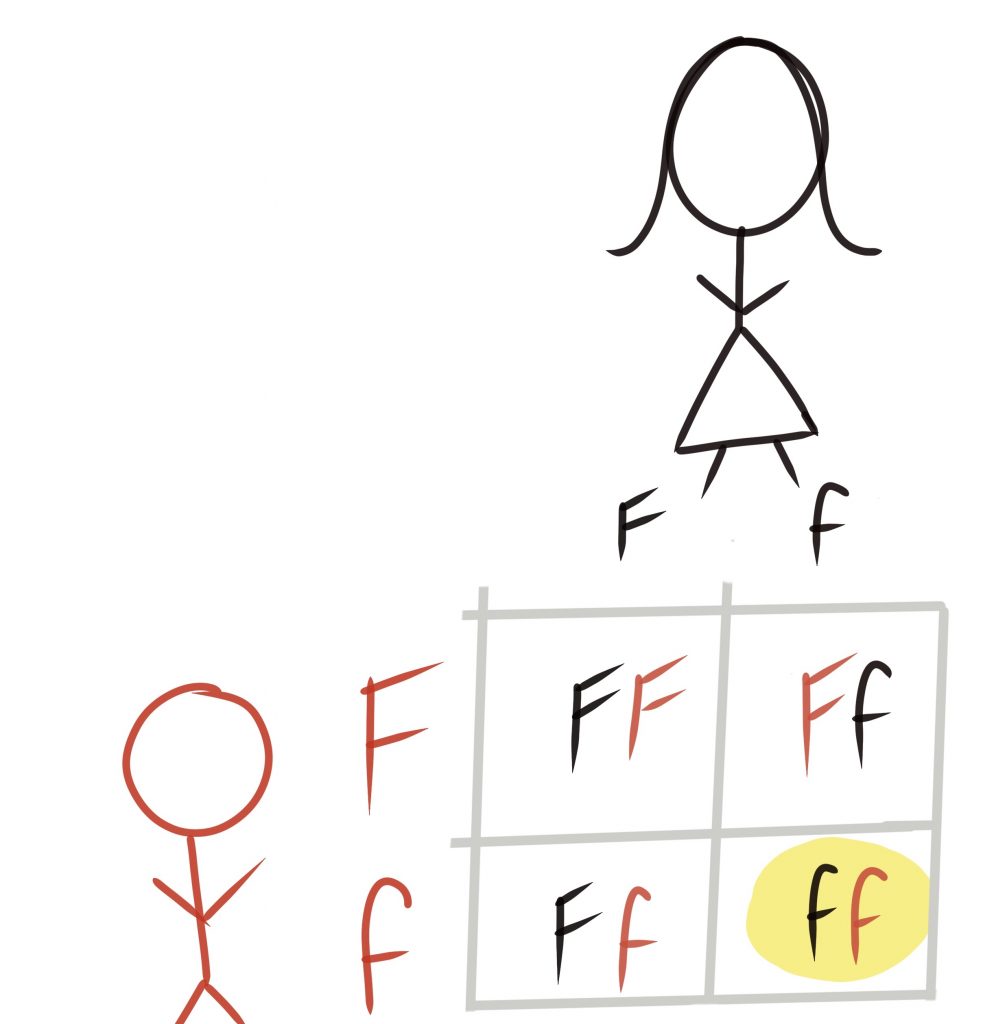
In this case, if only one parent is a carrier of the disease and the other is homozygous (FF), there is no chance of any offspring suffering from cystic fibrosis.

Genetic Diseases & Syndromes- Genetic diseases are caused by mutations and some will affect the oral cavity and hence the treatment and care of our patients.
Developmental Abnormalities & Cleft-Lip and Palate- These can be due to environmental influences, but tend to have genetic components involved also. It is important to understand how these occur, in order to understand their treatment and management.
Disorders of Tooth Form and No.- Amelogenesis Imperfecta and Dentinogenesis Imperfecta are caused to do mutations in different genes. These can be in the genes of enamel matrix proteins or collagen, respectively.
Lesions - oral cancer and more- Oral cancer is the probably the most common lesion that students and clinicians relate to mutations. The mechanisms of oral cancer are still undergoing research, but many involve the expression of different proteins and enzymes - and mutations that occur in the genes associated with these.
You should now be able to grasp the key concepts of genetics and inheritance. This will allow you to apply these rules when reading about developmental abnormalities or genetic diseases.