We learn how to care for our patients to the highest level but how do we look after ourselves?
Despite difficulties in obtaining data, premature retirement due to health problems in dentists, is 4 times higher when compared to medical doctors at a similar stage of their career, with musculoskeletal disorders (MSDs) being the most cited group of conditions.1
MSDs involves injuries or pain to muscles, bones, joints, ligaments, tendons, nerves and blood vessels. Long procedure times, awkward and static postures, repetitive motions, forceful exertions, contact stresses (e.g. gripping a handpiece) and vibrations, are important risk factors for MSDs.2
Whilst the musculoskeletal system has some obvious roles, including walking and general movement, it fulfils other, more subtle functions, such as posture and joint stability. One example is the spine. When the curves of the spine are balanced and align perfectly against the centre of gravity, the spine is supported by the bony structures beneath. However, when the natural curvature is lost (often when working over a patient), the spine begins to depend on muscles, ligaments and soft tissues for support, resulting in constant low-grade contraction.
Human muscles which have not been conditioned for long-lasting contractions require rest periods to recover. During these contractions, compression of the vascular supply can lead to ischaemia reducing the delivery of oxygen and nutrients. In addition, lactic acid accumulation occurs, which historically has been viewed as the cause of pain; however, some research indicates that the lowering pH, indirectly caused by metabolites, triggers nociception.2,3
Lower back pain has been reported in up to 70-90% of people. Its causes are likely to be multifactorial, in addition to the combination of lumbar flexion with rotation, putting strain through the lumbar discs. Further exacerbation of disc problems will occur with inflexible hips and pelvis. Moreover, the abdominal and gluteal muscles, which aid in stabilizing the lumbar spine, are frequently weak as a result of prolonged seating.4
Neck and Upper back pain is less common than lower back pain. Cervical flexion induces torque (rotational force) which needs to be resisted to prevent our heads from falling forwards. The erector spinae muscle group, spans from the sacrum all the way to the base of the cranium and help to support the head.5 The lumbar region of the erector spinae resist a similar torque during forward tilting of the pelvis. With continued contraction to stabilise the head and pelvis, as mention previously, blood flow is reduced, due to compression and a lack of dynamic movement, leading to muscular, skeletal and nerve tissue degeneration.5
Chronic and repetitive flexion and extension of the wrist and fingers can be detrimental to our hands. This can lead to tendinitis or carpal tunnel syndrome amongst other conditions.4
| Signs of MSD | Symptoms of MSD |
Decreased range of motion | Excessive muscular fatigue |
Loss of normal sensation | Tingling, burning or pain in our limbs |
| Reduced grip strength | Weak grip |
Loss of normal movement | Numbness in fingers |
Loss of coordination |
The dentist must first get themselves into a balanced posture before adjusting the patient. The balanced posture includes:
The use of loupes or other magnification systems can be useful for maintaining a healthy posture.6
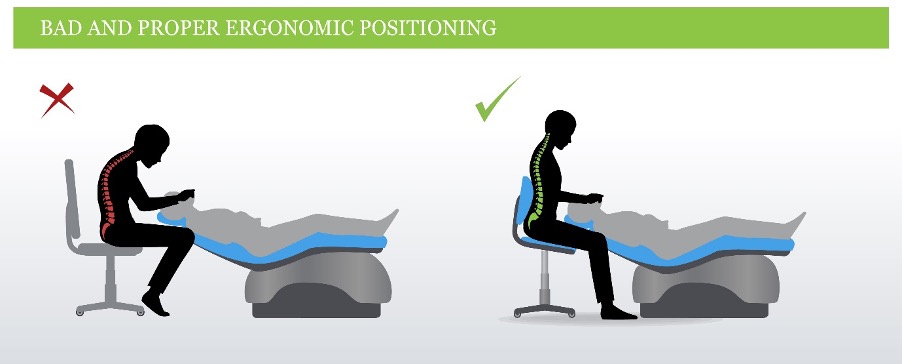
Many physios will echo the point of a healthy posture and ergonomics; however, newer research is starting to conclude that there is no specific healthy posture that will prevent back pain. The problem arises from remaining in the same posture for long periods of time with a lack of movement variation. Sedentary behaviour has been linked with many chronic diseases, including cardiovascular diseases, obesity and leads to MSDs. Back pain can cause a lot of grief, discomfort and disability, reducing work efficiency, poorer mental health, and even negatively impacts the economy.7
Note: Whilst this referenced study focuses on university employees, prolonged sitting at a desk correlates well to the demands in dentistry.
As oral health professionals, we rely massively on our hands. We should be wary about wearing gloves that are too tight, to avoid reducing blood supply. Instruments with small diameters that require a pinch-grip or contact pressure to handle, as well as heavy instruments, should be avoided.8
It is understood that prolonged static work can lead to poor blood flow, overworked muscles and increased pressure on joints. A dynamic way of working can help mitigate this:
Aerobic exercises improve blood flow to all tissues in the body – supplying oxygen and removing harmful metabolites. There should be a warm-up and cool down of minimum of 5-10 minutes. The exercise should be quite intense – 70% of max heartrate (max HR = 220 minus age). This should be done for 20-30 minutes 3-4 times a week. Many activities can be utilised such as jogging, swimming, cycling or skipping.8
Even the ergonomically perfect posture will result in muscle tightness overtime, with up to 50% of the total body musculature being used. The idea is to stretch and relax these muscles and strengthen the antagonistic ones. For the stretches, aim to hold each stretch for 15-30 seconds and repeated 2-3 times a day. This can be done in the aforementioned microbreaks. The stretch should be slow, gentle and not cause pain.9
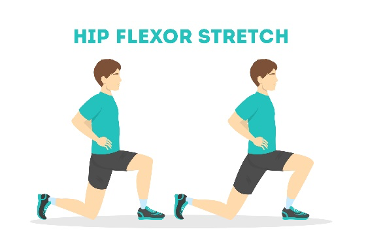
Go onto your left knee with your right leg at a 90o ahead of you. Keep your back straight and contract your abdominals and glutes. To increase the intensity of the stretch, lean forward more (straighten your back leg). Repeat on the other side

In a similar starting position for the kneeling iliopsoas stretch, however instead of your back leg placed on the floor, the foot is elevated (onto a chair, couch, wall or held with your hand). Ensure you stay upright. Increase the intensity by moving the knee close to the wall.
Stand in an open doorway, hands and forearms placed against the side of the doorway. Lean the body forwards from the ankles until you feel a stretch on the front of your shoulder and chest.9, 10
Raise one arm in front of you with the hand extended (like you are telling someone to stop). Use your other hand to bend the wrist into a more extended position. You should feel the stretch under the wrist.9
Some newer research has indicated that stretching alone is not necessarily the most effective way at increasing flexibility. Often, muscles feel tight when they are weak, rather than being too short. To help flexibility, there is the idea of eccentric strengthening.11 But what does this mean? I’ll use the bicep curl as a simple example:
Another good example for this type of exercise is the Romanian deadlift for hamstring flexibility – a slow controlled lowering action of the bar causes the hamstring to contract whilst lengthening at the same time – resulting in increased muscle length, and therefore flexibility via sarcomerogenesis.11
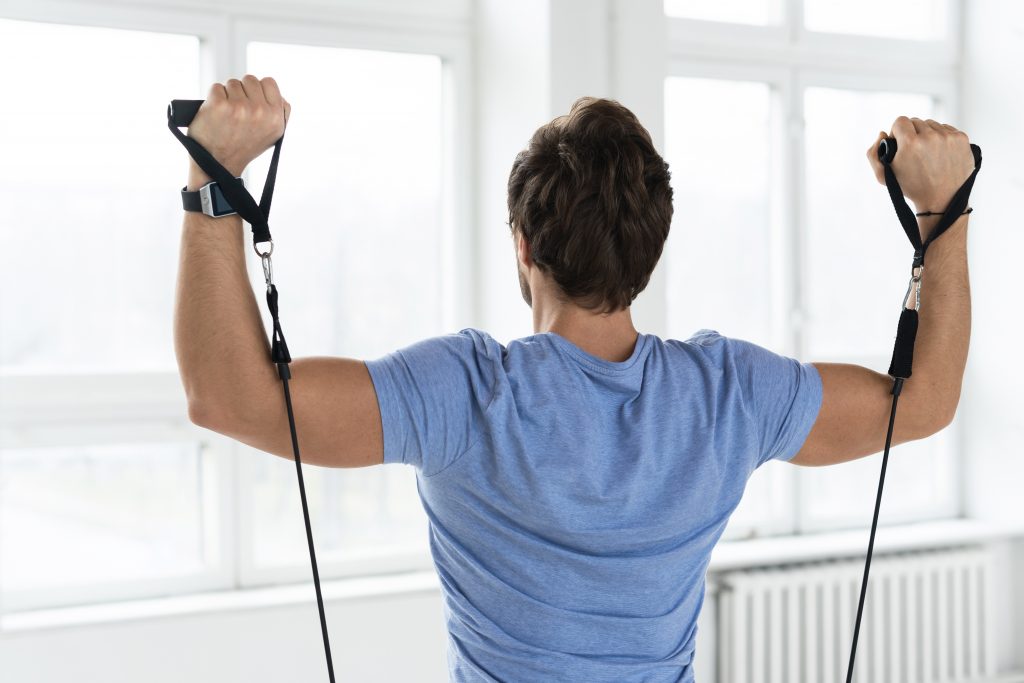
Using this knowledge is quite challenging to apply to the hip flexors. One example could be using a resistance band, as shown in this USA gymnastics video: Available
You would aim to have a fast concentric phase (1 second) and a slower, controlled eccentric phase (3 seconds). A willing partner could also be used to push your leg back down as you resist, if you do not own a band.
Just to note, traditional stretching is still widely prescribed by physios, it is not necessarily wrong to include it, replace it with eccentric strengthening, or do both - it can depend on the physio’s opinion.

Stand back to the wall with the feet a little bit away. Keep the glutes, back, shoulders and the back of your head close to the wall. It is important to contract your abdominals to ensure your lower back remains in contact to the wall throughout the exercise. Slightly tuck the chin to ensure a straight cervical spine. Place your upper arms, forearms and hands over your head and onto the wall (V position). Whilst keep those three points in contact with the wall, bring your elbows down to your sides. Repeat 10 times. An easier version is the floor angel.10
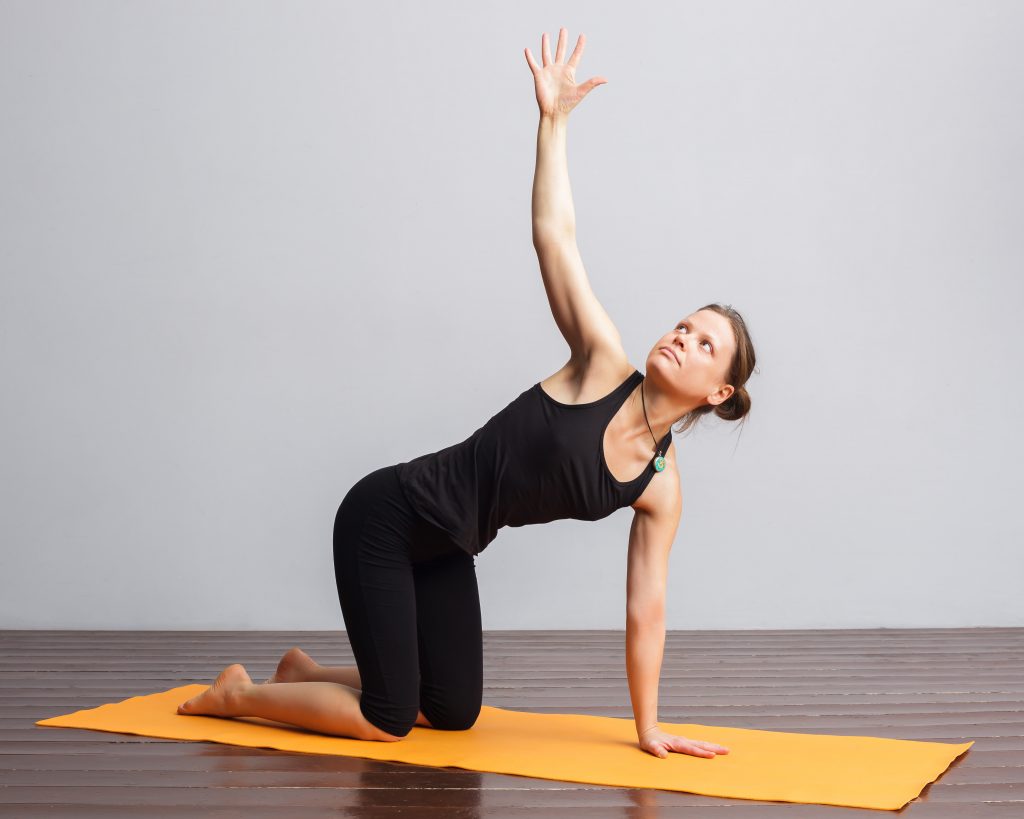
Go on your hands and knees. Place your hands on the floor directly beneath your shoulders, knees bent at 90owith your hips directly above your knees. Place your right hand on the back of your head, then rotate your trunk to get your right elbow near your left elbow. After this, open up your spine by rotating to point your right elbow to the sky and squeeze your shoulders blades together. Repeat 10 times on each side.10

Whilst on hands and knees, facing a platform at shoulder height e.g. a chair or bench (at the gym), bring you elbows to rest on its surface. From this position, push you hips back towards your heals and lower your head through the space in your arms. In a fluid motion bring your hands from their start position to the base of the neck. Breath with the movement and repeat. Think childs pose from yoga.

Feet on the floor with elbows directly beneath your shoulders. Elevate your body from this position. Contract your abdominals and glutes to ensure a straight spine. Start with short holds e.g. 30 seconds and work your way up to longer holds.10

lay on your back with your thighs perpendicular to the floor with the knee at 90o. Contract your abdominals to ensure your lower back is in contact with the floor the entire time during the exercise. Lower your hips until your feet touch the floor, whilst maintaining the knee angle and elevate back to the starting position. Aim for 2-3 sets of 10 repetitions. Increase difficulty by gradually straightening the leg at the knee10


Note: We recommend seeking professional advice e.g. from your GP or physiotherapist before beginning any new exercise regime or experience signs or symptoms of musculoskeletal disorders.
Excellent eyesight is a necessity in dentistry – from shade matching to radiographic interpretation. The insidious onset of eye changes has led to suggestions that all dentists should have an eye examination at least every 2 years until the age of 50 and more frequently thereafter.12 A recent survey has shown that 31% of dental students were unsure if their eyesight was satisfactory for practice.13
Even with eye check-ups, we are at risk from flying debris, pathogenic contamination and chemicals. One study found that eye injuries accounted for 10% of occupational injuries to dental personal.14Despite the BDA advocating for eye protection, a survey found that only 47% of dentists comply.12The optimum protection involves personal glasses fitted with plastic lenses and additional side shields.
Visual performance reduces with increasing age. This includes reduced visual acuity (the ability to detect fine visual details) and presbyopia (gradual worsening ability for the eye to focus on nearby objects). Magnification, such as loupes or an operating microscope, can compensate for visual deficiencies.15
A hazard that can damage our eyes that is routinely used is the light curing unit (LCU). Historically, LCUs used UV light for photopolymerization before the transition to visible light due to health concerns. More precisely, blue light is utilised, which is on the short wavelength (400-500nm) aspect of the visible light spectrum.
Advancements in LCUs have paved the way for more powerful and intense lights resulting in a shorter working time, less chance of bracket movement in orthodontics and reduced saliva contamination risk; however, the potential disadvantage is an increased risk to our eyes. Namely, overexposure to blue light (shown to be the most harmful visible light) can result in dryness and ocular inflammation as well as apoptosis of the cornea. Overexposure includes more than 1 second of direct accidental exposure per day. Ensure the use of protection filters to protect the patient’s, nurse’s and your own eyes.16
Our eyes play a massive role in our ability to practice dentistry to a high standard. We need to maintain our optimal eye health to ensure our general health remains a good standard. See third party link for more information on eye care.
It is important to keep active, especially in a career which can keep us static for long periods of time. The lesson above explains the impact a career in dentistry can have on our bodies if we don't care for them properly, and introduces the fundamentals of physical care, whilst providing some examples that could help. If you are ever unsure on how to perform various exercises or the examples given here, it is advised to seek out a professional who can coach you through them, to prevent injury.
General advice on eye care: available