Anticoagulants and Antiplatelet Drugs
This lesson will cover the process of blood clotting, as well as the pharmacology of anticoagulants, antiplatelets and haemostatic agents.
Introduction
- Anticoagulants and antiplatelets are two very important types of drug that you will encounter within the patient population. They are used to decrease the ability of the blood to clot, and sometimes are referred to as “blood thinners”.
- As lot of procedures in dentistry carry a risk of bleeding, patients taking anticoagulants/antiplatelets require special consideration. We must adapt our treatment to prevent excessive or prolonged bleeding.
- This lesson will explain how the blood clots and how anticoagulants and antiplatelets fit into the mechanism to prevent it. We will also briefly touch on drugs used to aid haemostasis and those used to break down clots (fibrinolytics).
- Please note that this topic will be covered broadly as it is designed to give the basic mechanisms - the depth of specific mediators involved is not covered but is available through the references if required.
- At the bottom of the lesson there is also a link to SDCEP guidance which covers how these patients should be treated in the clinic - it is beyond the scope of this lesson to cover the guidance in depth (as it is frequently reviewed and updated).
Definitions of terms used in this lesson:
- Anticoagulants: Drugs that antagonise the coagulation cascade.
- Antiplatelets: Drugs that inhibit platelet aggregation.
- Thrombogenic factors: Pro-clotting factors.
- Haemostasis: Clotting of blood/stopping the flow of blood.
- Coagulation: Blood clotting
- DPF: Dental Practitioner’s Formulary – found in the BNF, it lists the drugs that a dentist can prescribe on an NHS prescription.
- OTC: Over-the-counter - drugs that can be purchased.
Haemostasis
What is the point of haemostasis?
- Haemostasis is a defence mechanism to preserve blood volume and allow healing.
- In some situations, a blood clot forms within the blood vessel when it is not needed – this blockage can cause catastrophic events such as stroke, deep vein thrombosis, and heart attacks (myocardial infarction). These can be life changing events, and so the value of anticoagulants/antiplatelet drugs should not be underestimated.
- Haemostasis is a balanced, finely regulated system. (1)
Healthy blood flow (1)
Many systems in the body rely on a balance of chemical mediators and the blood is no different.
- There is a balance between vasoconstrictors and vasodilators produced by the cells which line the wall of the blood vessel:
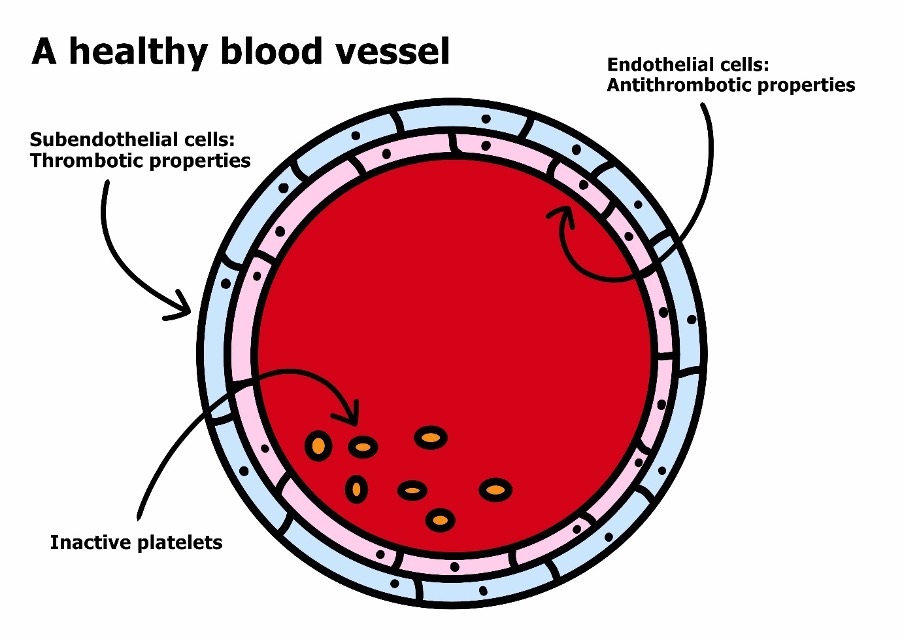
- In health, platelets are present in the blood and are smooth and inactive.
- There is also a balance of thrombogenic and antithrombogenic factors in the body.
- Thrombogenic:
- Exposed subendothelial cells containing collagen and Von Willebrand Factor (vWF)
- Endothelial cells possess antithrombogenic factors, whilst subendothelial cells possess thrombogenic properties.(1)
Now imagine there is an injury to the body:
- Damage to the body leads to ruptured blood vessels.
- When a blood vessel ruptures the subendothelial cells are exposed – remember these cells possess thrombogenic factors.
- There is now an imbalance between thrombogenic and antithrombogenic factors – clotting therefore begins at the site of injury.
The Two Stages of Haemostasis
Primary Haemostasis (2)– vasoconstriction and the platelet plug
- This is the immediate response to damage and involves the formation of a platelet plug.
- First there is a momentary arteriole vasospasm which reduces blood flow to the affected area. This constriction of arterioles is caused by:
- Nerve reflex
- Release of endothelin by damaged endothelial cells
- This is shortly followed by platelet activation
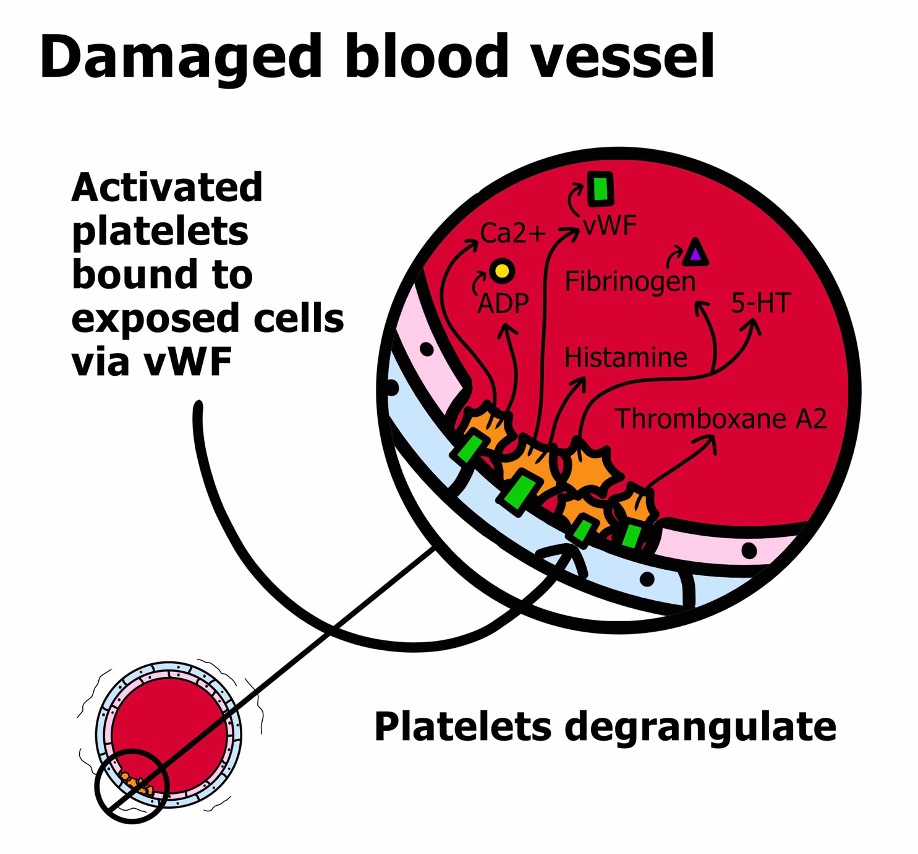
- Platelets stick to exposed collagen in the subendothelial cell layer, utilising vWFand change from smooth to spiny in shape.
- Platelets then degranulate, releasing many factors including:
- Von Willebrand Factor (vWF): Helps platelets further adhere to exposed subendothelial cell collagen.
- Thromboxane A2: Promotes platelet activation and aggregation.
- Serotonin (5-HT): Causes vasoconstriction.
- ADP: Causes further platelet activation.
- Histamine: Acts to dilate and increase permeability of blood vessels – aids with transport of the immune system to site of injury.
- Fibrinogen: Converted to fibrin in secondary haemostasis.
- Ca2+: Used in secondary haemostasis for the maturation of the clot.
- ADP binds to platelets via the P2Y12receptor, causing a conformational change to GpIIb/IIa receptors. This shape change allows the GpIIb/IIa receptorsto bind to fibrinogen, ready for secondary haemostasis.
Secondary Haemostasis – Conversion of fibrinogen to fibrin (1,3)
- This is maturation of the platelet plug to a stable clot and occurs by activation of the coagulation cascade.
- The goal of this cascade is the conversion of fibrinogen to fibrin, which crosslinks and stabilises the clot.
- Cross-linking of fibrin strands is aided by Ca2+, which you will remember was released from platelets back in primary haemostasis.
- It is important to note - whilst the platelet plug is forming, the coagulation cascade is also occurring, ready to convert fibrinogen to fibrin.
The coagulation cascade:
Involves the activation of many factors in sequence.
- Many of these factors are produced in the liver – important to remember that liver disease can decrease the ability of the blood to clot. (See “Systemic disease” lessons for more information on liver disease).
- Each activated factor goes onto activate the next, hence the name “cascade”.
- The factors are given numbers, but also have names – e.g. Fibrinogen is factor I, when activated it becomes Fibrin (factor Ia).
- There are two ways that this cascade can be activated:
- Intrinsic pathway– internal damage to vessel wall
- Extrinsic pathway– external damage to the tissues (this is a faster cascade) - The two pathways converge at Factor X and become the common pathway.
- Remember, the goal is to convert fibrinogen to fibrinfor crosslinking and strengthening of the clot.
Coagulation Cascade:
Tip to help you remember primary and secondary coagulation:
Imagine a pipe bursts in your house – the first thing you would do is turn the tap off and try to plug the leak. This is equivalent of vasoconstriction and the platelet plug in the primary haemostasis. (Obviously the body can’t close the blood vessel off fully because it still needs the blood to reach the tissues! But it can minimise the loss by reducing the flow of blood to this area). You’d then try and make this plug more secure to allow you to send in other people (cells!) to repair the damage. This act of securing the plug is the formation of the stable fibrin clot in secondary haemostasis.
Finally, how is coagulation reversed by the body?
- The breakdown of clots is vital, if they persist in the blood vessels they can narrow the lumen, reducing blood flow. In more serious situations, parts of the clot could break off and become lodged in other parts of the body, causing strokes or other cardiovascular events.
Prevention of further coagulation (3)
- Once the endothelial cells are repaired, the balance of pro-clotting and anti-clotting factors is restored.
- Endothelial cells release the antithrombogenic factors PGI2and NO, which prevent platelet adhesion to the walls of the vessel.
- In addition, endothelial cells also release antithrombin III which binds and inactivates both thrombin and factor Xa.
- Other antithrombogenic molecules are also released from endothelial cells which bind to various factors in the coagulation cascade, halting the process.
Fibrinolysis (the breakdown of the clot itself) (3)
- Fibrinolysis of the clot occurs via a protease called plasmin.
- Plasmin is produced when plasminogen is broken down by tissue plasminogen activator, which is released from endothelial cells.
Anticoagulants and Antiplatelet Drugs
Now we know the mechanism behind haemostasis we can slot the drugs in!
Anticoagulants - Oral
Warfarin – a coumarin
- Warfarin is used frequently as an anticoagulant but is slowly being superseded in primary care by the Novel Oral Anticoagulants (NOACs).
- It has many interactions and requires frequent monitoring to ensure that the patient remains within the therapeutic window.
- Once upon a time it was used as a pesticide – hence why some patients will refer to it as “rat poison”.
Mechanism of action (3)
- Essentially warfarin is a vitamin K antagonist.
- In health, vitamin K is reduced in the liver by vitamin K epoxide reductase complex 1 (VKORC1) enzyme. This reduction reaction activatesvitamin K, allowing it to participate in the production of factors II, VII, IX, and X.
- Warfarin acts in the liver to inhibit vitamin K epoxide reductase complex 1 (VKORC1), preventing it from producing these factors.
- Reduced amounts of these factors lead to reduced clotting ability as they are not available for the clotting cascade.
- Tip: A common method used to remember the factors is the date “1972”.
- Note: Liver disease can also decrease production of clotting factors – see “Systemic Disease related to dentistry” for more information.
Specific side effects (4)
- Prolonged bleeding and bruising are common side effects of this medication.
- Severe bleeds, including haemorrhagic stroke have also been reported.
Metabolism(3,5)
- As mentioned in the pharmacokinetics lesson, this drug is metabolised in the liver by the CYP450 family, in particular the CYP450 2C9 enzyme.
- Drugs that inhibit or induce these enzymes can increase or decrease the amount of warfarin in the blood (see interactions).
Monitoring(3,4)
Patients taking this medication will have their prothrombin time measured frequently. This is how long the blood takes to clot after the addition of tissue factor. The result is used to calculate the patient’s INR (International Normalised Ratio),which is a measure of how long their blood takes to clot compared to the average person.
So because tissue factor is only involved in the extrinsic pathway, the prothrombin time test measures the extrinsic and common pathways of the coagulation cascade as (refer to the coagulation cascade diagrams to help you visualise this).
More detail about the INR
- An INR of 1 is the average clotting time of a person not taking blood thinners.
- An INR of 2 would mean the blood takes 2x as long to clot compared to “average”
- Patients will have a target INR for their condition. This will usually be between 2.5-3.5 depending on the patient.
- The INR is checked at regular intervals (these intervals depend on the stability of the INR).
- The INR determines the dose of warfarin that the patient will take.
- This information is all recorded in the patient’s “Yellow book”
Clinical relevance
The INR is important when it comes to treating patients with procedures likely to cause bleeding. It is of particular importance when considering extractions – for an extraction to be carried out the INR must have been checked within the last 24hrs and must be below 4 (72hrs is acceptable for stable INRs, but 24hrs is the maximum for unstable INRs). Haemostatic measures such as suturing may also be recommended. See SDCEP guidelines for more information. (6)
An example of a yellow book:
Interactions(4)
Warfarin has many interactions as previously mentioned. Some dentally significant ones include:
- Miconazole (fatalities reported) – Increases INR(7)
- Fluconazole - Increases INR
- Metronidazole - Increases INR
- Penicillins - Increases INR
- NSAIDs – Increases risk of bleeding
- Alcohol - Increases INR
- Darky, leafy green vegetables, high in vitamin K – Decreases INR
- Carbamazepine – Decreases INR
Be cautious when prescribing to patients taking warfarin – if necessary, consult a GP for discussions regarding additional monitoring of the INR, or a pharmacist for advice on alternative drugs.
Treatment in overdose (4)
- Vitamin K can be administered to counteract the effects of warfarin. This is an advantage of warfarin over the NOACs, which are less easily reversed.
Clinical tip
- Because warfarin is a drug with a narrow therapeutic window, manufacturers have colour coded the strengths to help ensure patients do not take the wrong tablets.
- Currently in the UK:
- 500 microgram tablets are white
Novel Oral Anticoagulants (NOACs)
These drugs are newer than warfarin, and do not require as much extensive monitoring. They still have many interactions but are less affected by diet. There are two subcategories, factor Xa inhibitors and direct thrombin Inhibitors.
Factor Xa inhibitors
- Rivaroxaban
- Edoxaban
- Apixaban
Mechanism of action:
- Inhibit factor Xa to prevent the conversion of prothrombin to thrombin (3)
Tip for remembering the mechanism of these drugs: All have “Xa” in the name and all inhibit Xa.
Direct Thrombin Inhibitors
Mechanism of action:
- Work by inhibiting thrombin, preventing the conversion of fibrinogen to fibrin. (3)
- We have covered this in the coagulation cascade, thrombin is activated prothrombin.
Interactions(4)
A couple of examples:
- NSAIDs – increased risk of bleeding
- Carbamazepine – decreases concentration of NOACs
Anticoagulants - Injectable
Heparin and Low Molecular Weight Heparins (LMWH)
These are injectable anticoagulants and don’t tend to be for long term use (most patients will either be on a short course of injections, or eventually swapped onto oral anticoagulants), but you still may meet patients who are using them.
Heparin is a slightly larger molecule than LMWH - they have slightly different mechanisms of action.
Examples of each:
- Heparin
- Commonly known as unfractionated heparin
- Low Molecular Weight Heparin
Mechanism of action
Heparin:
- Potentiates antithrombin III action on both thrombin and factor Xa. Remember, antithrombin III binds to, and inactivates, thrombin and factor Xa, preventing coagulation. (3)
LMWH:
- Potentiates antithrombin III action on factor Xa only. (3)
Heparin and LMWH side effects (4)
- Bleeding, bruising etc.
- Heparin induced thrombocytopenia (low platelet count, less common with LMWHs)
Monitoring
- Heparins can be monitored by measurement of the activated partial thromboplastin time (aPTT).
- The aPTT test measures the speed the blood takes to form a fibrin clot.
- In particular this test measures the intrinsic and common pathways (as opposed to
- the prothrombin time, which measures the extrinsic and common pathways). (8)
- A sample of blood is taken, then calcium and a contact activator are added to trigger the intrinsic cascade. (9)
- The time taken for a clot to form is measured.
- LMWH do not usually require monitoring for routine treatment. (4)
Treatment in overdose (4)
- Protamine sulphate – binds to heparins inactivating them.
Interactions(4)
- NSAIDs – increased bleeding
- Anticoagulants and antiplatelets – increased bleeding
- See BNF for more information.
Antiplatelets
These drugs act on the platelets in the body to prevent clotting.
Aspirin
We have already covered the use of high dose aspirin as an anti-inflammatory in the “Pain – NSAIDs and Paracetamol” lesson. Low dose aspirin (75mg daily) is used as an antiplatelet, and has a particularly interesting mechanism of action which ties together parts of the “Pain – NSAIDs and Paracetamol” lesson, as well as the “Pharmacokinetics” lesson.
Mechanism of action (3)
First we must consider some background information - let us refresh our knowledge of the COX enzymes of the arachidonic cascade from the “Pain – NSAIDs and Paracetamol” lesson.
Note: thromboxane A2, a product of the COX pathway, is involved in platelet aggregation. You will also recognise thromboxane A2 from the start of this lesson. We discussed that it is a thrombogenic factor released from platelets when they degranulate.
- We also need to remember that when aspirin is given orally it is absorbed from the GI tract and enters the body via the portal vein. You will remember this absorption pathway from the “Pharmacokinetics” lesson.
- When aspirin passes through the liver some of it is metabolised to a variety of products including salicylic acid which has no antiplatelet effect (but does function as an anti-inflammatory). (10–12)
Now we have all the background information we can piece the mechanism together: (3,10)
- Oral low dose aspirin (75mg) is absorbed from the GI tract and enters the hepatic portal vein.
- Whilst in the portal vein aspirin moves into the platelets and irreversibly inhibits COX-1, the enzyme responsible for thromboxane A2 synthesis.
- Irreversible inhibition of thromboxane A2 synthesis means that there is decreased thromboxane A2 released from degranulating platelets. Overall this leads to decreased platelet aggregation.
- The platelet has no nucleus, and so cannot produce more COX-1. This means the thromboxane A2 production is permanently prevented in this platelet and the effects can only be reversed when new platelets are generated.
- By giving aspirin orally we ensure that it has an opportunity to selectively move into platelets in the portal vein, before being metabolised in the liver.
Interesting things to note: (3)
- Aspirin also enters the endothelial cells and inhibits COX-1, however because endothelial cells possess a nucleus, they can produce more COX-1 enzymes and overcome this inhibition.
- High dose aspirin affects both the platelets and endothelial cells and is associated with a higher risk of GI bleeding. The lower dose is effective as an antiplatelet, with fewer side effects.
Side effects (4)
- Increased risk of bleeding
- GI irritation
Interactions(4)
- Other anticoagulants and antiplatelets – increased risk of bleeding
- NSAIDs – increased risk of bleeding
- Selective Serotonin Reuptake Inhibitors (SSRIs) – increased risk of bleeding
Clinical Tip:
When you take a drug history from your patient it is important to ask about OTC medication.
Low dose aspirin (75mg) may not always be prescribed and instead patients will purchase it OTC from pharmacies. It often costs less than £1 for a pack of 100 tablets and for this reason many patients will forget to mention it as it seems so trivial.
Adenosine receptor antagonists (P2Y12receptor antagonists)
Examples:
- Clopidogrel
- Prasugrel
- Ticagrelor
Mechanism of action (3,13)
- These drugs inhibit the binding of ADP to the P2Y12 receptor on the platelet. This prevents activation of the GPIIb/IIIa complex, and prevents the binding of fibrinogen.
- These drugs can be split into reversible and irreversible inhibitors: (14)
Dipyridamole
Mechanism of action (3)
- Works in a couple of different ways, including inhibiting the synthesis of thromboxane A2 and as an adenosine uptake blocker, reducing the amount of ADP released by damaged cells.
Clinical use:
Less commonly used, but can be co-prescribed with other anticoagulants/antiplatelets.
GPIIb/IIIa receptor antagonists
We will cover this area for completeness, but the drug described here is not used for long term treatment, it is only administered for those undergoing cardiac procedures. (3)
Example:
- Abciximab – a monoclonal antibody
Mechanism of action (3)
- Binds to and inactivates the GPIIb/IIIa receptor.
Clinical use (3)
- Often only used once in patients, as an immune response to the drug frequently develops.
Haemostatic drugs
In dentistry we are mostly concerned with the patient bleeding excessively after a procedure. It is therefore appropriate to discuss any drugs used to aid haemostasis.
Example:
Mechanism of action (3)
- Prevents the activation of plasminogen to plasmin. This slows the breakdown of clots.
- It does this by binding to plasminogen, blocking the plasminogen activators, such as tissue plasminogen activator, which we mentioned earlier.
Clinical use:
- Tranexamic acid can be given orally – in the dental setting you may see it used as a mouthwash to arrest bleeding after an extraction or surgical procure.
- It is not listed in the DPF, this means it can only be prescribed privately. In addition, tranexamic acid is not available as a mouthwash and must be prescribed as an unlicensed preparation. This means that the drug is prescribed outside its UK license. For extra information about unlicensed prescribing please see the references. (15)
- The SDCEP guidelines do not advise primary care practitioners to prescribe tranexamic acid for dental procedures. There is an exception to this - if a doctor has consulted with the patient and has prescribed tranexamic acid mouthwash for dental procedures, the SCDEP guidance states that the mouthwash should be used. If unsure it is best to consult with the patient’s GP and come to a joint decision. (6)
Other drugs that affect coagulation – fibrinolytic drugs
These drugs are used to breakdown clots in the body. They are not as relevant in the dental setting, but we will briefly mention them for completeness.
Examples (not exhaustive):
Clinical use
- Fibrinolytic drugs are often used in the treatment of stroke or myocardial infarction.
What does this all mean in dentistry?
It is beyond the scope of this lesson to cover the guidelines, but in short you may need to alter how you treat your patients depending on the type of anticoagulant or antiplatelet drugs they are taking. The SDCEP has created guidance for dental practitioners which can be found in the references. (6)
You will also find that some of the drugs in the DPF will interact with anticoagulants/antiplatelets – be cautious and always opt for the safer option where possible.