DPF– Dental practitioner’s formulary – Found in the BNF, this is a list of drugs that can be prescribed by a dentist on an NHS prescription.
Guanine– one of the four DNA bases that constitutes the DNA strand structure.
Introduction
Whilst some of the infections we see in dentistry are caused by bacteria, there are many other diseases which are caused by a fungal or viral infection. Examples include oral thrush (a commonly seen fungal infection) and cold sores (caused by the herpes simplex virus). In practice we may need to treat these infections with antifungal or antiviral drugs; therefore, in this lesson we will explore how they work, as well as highlighting some clinical tips when prescribing for patients.
Antifungals
Examples of fungal infections seen in dentistry:
Oral thrush – often caused by candida albicans
Median rhomboid glossitis – thought to be caused by a candidal infection (1) Seen on the dorsal surface of the tongue: depapillated/ erythema/ atrophic.
Angular cheilitis – can be caused by candida as well as by bacteria. (2)
Structure of fungi
The structure of a fungal cell is different to that of an animal or bacteria. In the simplified diagram below you can see that fungal cells contain a cell membrane made from ergosterol, whereas the primary component of a human cell wall is cholesterol. Logically this seems a good target for antifungal drugs - ergosterol is specific to the fungal cell structure and therefore, helps the drug to discriminate between human and microbe. The antifungals we use in dentistry target the cell membrane.
Azole antifungals
Examples
Fluconazole (in DPF)
Miconazole (in DPF)
Clotrimazole (not in the DPF, but one of the most common antifungals used topically – available over the counter)
Mechanism of action
These antifungals work by inhibiting lanosterol 14-alpha-demethylase, an enzyme responsible for ergosterol synthesis. (3)
Without ergosterol the structure of the fungal cell membrane is compromised, preventing the fungi from replicating. (4)
Interactions (2,5)
Azole antifungal drugs act as inhibitors of CYP450 enzymes and so may have many interactions. Generally the interactions are only significant when the drug is given systemically, but below is an important exception:
There is a significant interaction between warfarin and miconazole.
Miconazole dramatically increases the effects of warfarin, resulting in a higher INR (see “Anticoagulants and Antiplatelets lesson). (2,6)
This interaction applies to all forms of miconazole (including topical products such as the oral gel), and so miconazole should never be prescribed or recommended to a patient taking warfarin. Tragically fatalities have been reported when miconazole oral gel was used by patients taking warfarin. (7)
SDCep also advise to avoid prescribing azaleas if the patient is taking Statins or Theophylline.
Side effects (2)
Topically there are minimal side effects but remember that these products can be absorbed systemically.
Avoid during pregnancy, due to risk of fetal malformations. Nystatin can be used instead.
Clinical tip
Miconazole oral gel is available for the public to purchase over the counter from pharmacies.
Caution must be taken with miconazole oral gel use in children under the age of 4 months (or under 6 months in premature infants) as it poses a choking hazard. (2)
Antifungal drugs are available as combination products and are mixed with a corticosteroid in the form of a cream or ointment. This helps to treat the fungal infection and reduce the inflammation associated.
Polyene antifungals
Example
Nystatin (in DPF)
Mechanism of action
Polyenes also target the ergosterol of the fungal cell membrane, but instead of inhibiting the synthesis (like azole antifungals), they bind directly to the ergosterol. This binding creates pores in the fungal cell membrane causing leakage of ions and preventing fungal cell growth. (4,8)
Side effects
Nystatin is not absorbed from the GI tract and so side effects are less common. (2)
Administration
Nystatin is available as a suspension and should be dropped into the mouth and kept in contact with the affected areas for as long as possible. (9)
Clinical tip
Due to a patient’s medical history, nystatin may sometimes be more suitable than azole antifungals for oral thrush. Whilst patients can purchase miconazole oral gel from pharmacies, nystatin is prescription only.
Antivirals
What is a virus?
Viruses are some of the oldest and most bizarre microorganisms on the planet. Their replication cycle uses the host’s cell machinery, and so this makes treating viral infections complex. Often it is difficult to kill the virus without damaging the infected cell. Additionally, the structure of a virus is generally small and simple meaning there is less to target than the more complex cells such as bacteria or fungi. Many antivirals currently on the market target the replication process, but often there are no treatments for viral infections. In situations where there is no treatment (and a virus is dangerous, or causes long term harmful effects), we must rely on vaccination programmes to prevent the disease.
Dental example: Human papilloma virus (HPV) is a virus that is known for causing genital warts and oral papillomas. We also know that people infected with HPV are more likely to develop cervical and oral cancers. (10) The HPV vaccination program was introduced to the UK in 2008 - since then there has been a decline in incidence of cervical cancer. We also hope that uptake of the vaccine will help prevent oral cancers in patients in the years to come. (11)
Examples of viruses encountered in dentistry (12–15)
Please see the references for more detail regarding the characteristics of these viral infections, as well as further examples.
Herpes simplex – Cold sores
Recurrent HSV
Human papillomavirus (HPV) – Associated with increased risk of oral cancer
Herpes varicella – Chicken pox
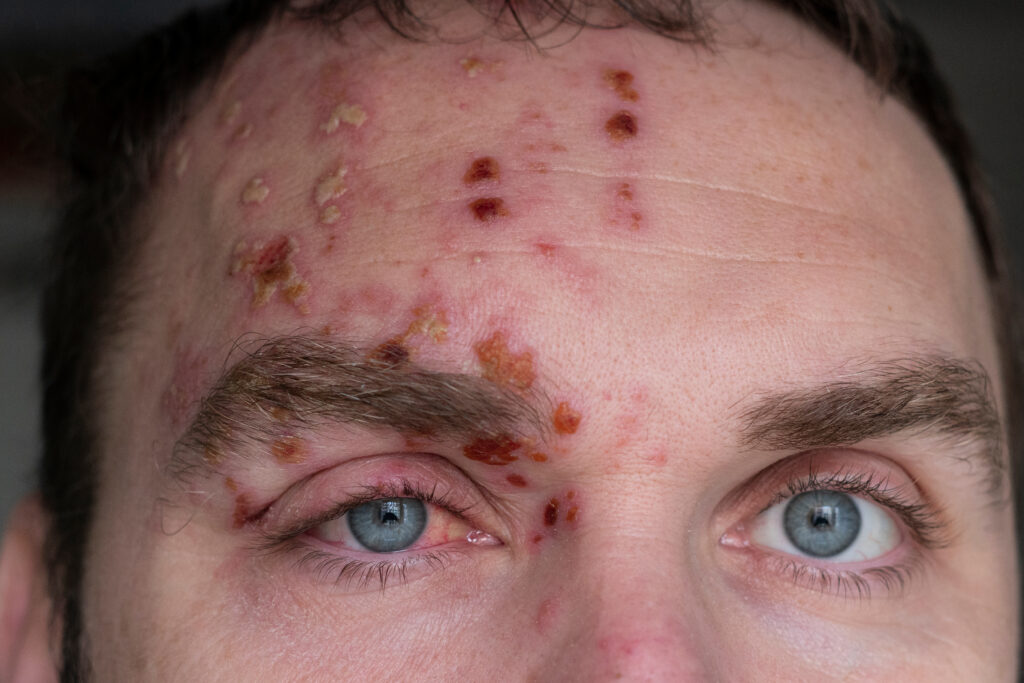
Herpes zoster – Shingles
Shingles: Note the nerve pattern the virus follows
Human immunodeficiency virus (HIV) – A virus which destroys immune cells (specifically CD4+ T cells)
Examples of antiviral drugs
Aciclovir (in DPF)
Valaciclovir (not in DPF, prescribe on private prescription only)
Famciclovir (not in DPF, prescribe on private prescription only)
Mechanism of action of aciclovir (4,8,16,17)
Aciclovir is a prodrug that is activated by an interesting pathway:
First it is phosphorylated by the herpes virus thymidine kinase enzyme.
After this, it undergoes further phosphorylation by human guanylyl kinase enzymes to its active form, aciclovir triphosphate.
As aciclovir must be first phosphorylated by the herpes virus enzymes, it remains fairly selective to infected cells.
The active form of aciclovir then acts as a guanine analogue and is incorporated into the viral DNA as the virus replicates. In other words, the aciclovir triphosphate replaces guanine in the forming DNA strand.
As aciclovir is slightly different in structure to guanine, incorporation results in the inhibition of DNA chain formation - additional nucleotides are unable to bind.
This process prevents further viral replication.
Clinical use
Aciclovir is the most used antiviral in dentistry. It is in the DPF and therefore, can be prescribed by dentists on an NHS prescription.
Aciclovir is available as a cream for topical use. Alternatively, for immunocompromised patients, it can be prescribed systemically. See the SDCEP guidance for more information on aciclovir and other antiviral agents used in dentistry. (18)
Interactions (2)
Aciclovir interacts with theophylline and aminophylline, two drugs sometimes used in asthma and COPD. This interaction may require a dose change of the theophylline and aminophylline, so it is recommended you liaise with patient’s GP if aciclovir is to be given systemically.
There are other interactions listed in the BNF which can increase the risk of nephrotoxicity, so proceed carefully in the elderly and in those with kidney disease. The BNF recommends that these patients are maintaining adequate hydration.
Clinical tip
Aciclovir cream is available over the counter as a treatment for cold sores.
Patients can purchase this medication for use as soon as they feel a cold sore beginning.
Conclusion
In this lesson we have covered the mechanisms of action for the antifungal and antiviral drugs used in dentistry. There are fewer options for treating fungal and viral infections (when compared with bacterial infections), but nonetheless they can usually be effectively managed with the drugs available.
References
Goregen M, Miloglu O, Buyukkurt MC, Caglayan F, Aktas AE. Median Rhomboid Glossitis: A Clinical and Microbiological Study. Eur J Dent [Internet]. 2011 Oct [cited 2020 Sep 13];5(4):367–72. Available
Joint Formulary Committee. British National Formulary (online) [Internet]. London: BMJ Group and Pharmaceutical Press; [cited 2020 May 28]. Available
Ritter J, Flower R, Henderson G, Loke YK, MacEwan D, Rang HP. Rang & Dale’s Pharmacology, Ninth Edition - ClinicalKey Student [Internet]. 9th Edition. Elsevier; 2020 [cited 2020 May 28]. Available
Brüggemann RJM, Alffenaar J-WC, Blijlevens NMA, Billaud EM, Kosterink JGW, Verweij PE, et al. Clinical Relevance of the Pharmacokinetic Interactions of Azole Antifungal Drugs with Other Coadministered Agents. Clin Infect Dis [Internet]. 2009 May 15 [cited 2020 Sep 13];48(10):1441–58. Available
MHRA. Topical miconazole, including oral gel: reminder of potential for serious interactions with warfarin [Internet]. GOV.UK. [cited 2020 Jun 22]. Available
BSDHT. Miconazole gel + warfarin - fatality following dental prescription - update from the MHRA [Internet]. [cited 2020 Jun 22]. Available
No-Hee Park, Ki-Hyuk Shin, Mo K. Kang. Antifungal and Antiviral Agents. In: Pharmacology and Therapeutics for Dentistry [Internet]. 7th Edition. [cited 2020 Sep 9]. p. 488–503. Available
EMC. Nystatin Oral Suspension BP - Summary of Product Characteristics (SmPC) - (emc) [Internet]. [cited 2020 Sep 9]. Available from: https://www.medicines.org.uk/emc/medicine/22396#COMPOSITION
Human papillomavirus (HPV) [Internet]. nhs.uk. 2019 [cited 2020 Sep 13]. Available
Kim SM. Human papilloma virus in oral cancer. J Korean Assoc Oral Maxillofac Surg [Internet]. 2016 Dec [cited 2020 Sep 12];42(6):327–36. Available
Santosh ABR, Muddana K. Viral infections of oral cavity. J Family Med Prim Care [Internet]. 2020 Jan 28 [cited 2020 Sep 12];9(1):36–42. Available
Pocket Dentistry. 21: Viruses of relevance to dentistry [Internet]. Pocket Dentistry. 2015 [cited 2020 Sep 12]. Available
Bonito AJ, Patton LL, Shugars DA, Lohr KN, Nelson JP, Bader JP, et al. Management of Dental Patients Who Are HIV Positive: Summary [Internet]. AHRQ Evidence Report Summaries. Agency for Healthcare Research and Quality (US); 2001 [cited 2020 Sep 13]. Available
HIV and AIDS [Internet]. nhs.uk. 2017 [cited 2020 Sep 13]. Available
Whitley RJ, Gnann JW. Acyclovir: a decade later. N Engl J Med. 1992 Sep 10;327(11):782–9.
Hirsch MS, Swartz MN. Drug therapy: antiviral agents (second of two parts). N Engl J Med. 1980 Apr 24;302(17):949–53.
SDCEP. Drug prescribing for dentistry: dental clinical guidance. [Internet]. 2016. Available