
This lesson covers the main principles of pharmacology, as well as defining several of the terms used.
Pharmacology is an area of science which studies how drugs work and how they are processed through the body.
As a dental clinician you must have a good understanding of the drugs you are prescribing and how they can affect your patient. Many of your patients will be taking medication prescribed by their GP, and drugs that you prescribe may interact with these. In addition, medications prescribed by the GP could have a major impact on the treatment we carry out e.g. anticoagulant medication increasing bleeding post extraction. It sounds nerve wracking, but by understanding the fundamentals and following the clinical guidance, you will ensure that the prescriptions you write are safe and appropriate.
Throughout the pharmacology lessons many terms will be used. Understanding these definitions will help support your understanding going forward:
This field covers drug absorption into the body, distribution around the body, metabolism and excretion. This is often abbreviated to A.D.M.E. Sometimes you will see the word “elimination” thrown around as well, technically elimination covers metabolism andexcretion.
Tip:(To help remember - To eliminate a drug you must remove it from the body. To do that it may need to be metabolised, then must be excreted)
This area deals with the effects of the drug on the body, from cell signalling pathways right up to measurable, physiological effects. It also covers side effects of the medication.
This is a developing area of science and covers how a person’s genetic makeup changes their response to a drug. Some people’s genetic variation means that they may produce slightly different enzymes or receptors. This means that certain groups of people may be more or less responsive, and so may require higher or lower doses drugs compared to your “average” patient. It also means they may be more or less susceptible to side effects.
Receptors are often targeted by drugs and are frequently involved in the mechanism of action. There are many different types of receptors; we will cover the basics later. Receptors can act to increase, decrease, sustain or block the body’s response to a stimulus.
Very simply a ligand is a molecule or compound that binds to another substance, which could be a receptor, and creates an effect. This can excite or inhibit the target, producing physiological effect.
In pharmacology often there will be reference to the “endogenous ligand”, which just means the body’s natural agonist or antagonist for the target.
Ligands or drugs that activate the receptor.
Ligands or drugs that bind to and inhibit the receptor.
Ligands or drugs that bind to a receptor but only cause partial activation or inhibition of the receptor compared to a full agonist/antagonist.
This is the primary binding site of a receptor.
This is another binding site on the receptor, but it is a physically different place to the primary site. Some drugs exert their effects by binding to the receptor in this way. They may be referred to as allosteric modulators. Often when the allosteric site is bound it causes the receptor to change shape (conformational change) and so the primary binding site also changes shape. This may lead to an increased or decreased response.

This concerns the concentration of the drug in the body and is a range. Above this range is toxicity and below leads to no beneficial effect. So, in simple terms, it is the concentration range at which the drug has a positive therapeutic effect. Generally speaking, the bigger the therapeutic window, the safer the drug.
Note: Often drugs with a narrow therapeutic window require frequent monitoring to ensure drug concentration is maintained.

Local administration refers to administration of the drug so that it only affects one area of the body (usually to try and minimise any systemic effects).
Systemic administration refers to administration of the drug where the drug is distributed in the systemic circulation.
Not all drugs are specific to one receptor and some receptors have multiple functions in different tissues. When a drug is administered systemically it binds to all available receptors it can access. The unwanted binding of the receptors often leads to side effects.
Some side effects are useful, but others may be detrimental to the patient or even dangerous.

As previously mentioned, administering a drug locally can reduce some of the unwanted systemic side effects.
You may see this word frequently in the BNF or clinical guidelines. It basically means “against-advice”. It is a broad term and indicates where caution should be applied, often when prescribing a drug with another drug or medical condition.
Contraindications usually require you to source an alternative drug for treatment. An absolute contraindicationmeans do not use,and should always be headed. If in doubt when prescribing, find an alternative or liaise with a doctor or pharmacist.
Drugs may interact with each other in a variety of ways. Some interactions are useful but often are unfavourable or even dangerous.
The BNF (appendix 1) contains a list of interactions and it is imperative that before prescribing a new drug the potential interactions are checked. Stockley’s Drug Interactions is a more detailed resource. Again, liaise with a pharmacist if ever unsure.
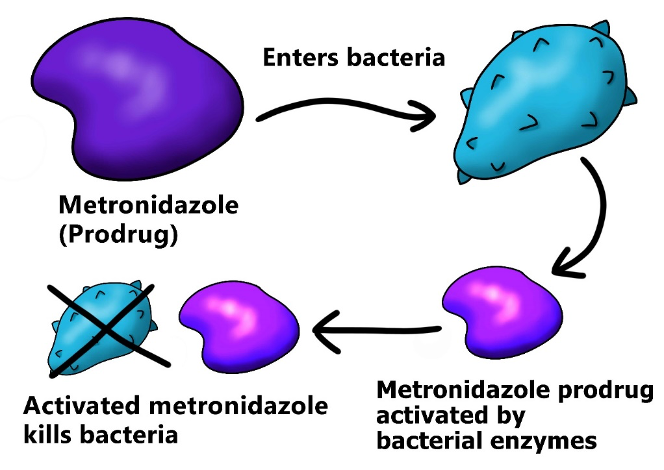
A prodrug is an inactive molecule which must be “processed” to become active and exert a pharmacological effect. This “processing” is usually metabolism by an enzyme. The enzymes may be from the host or pathogen, it depends on the drug.
Hopefully this has clarified some of the terms used in pharmacology. For more detail please refer to the individual lessons and resources below.
1. Ritter, J.M. Flower, R. Henderson, G. Loke, Y.K. MacEwan, D. Rang, H. P. Rang and Dale's pharmacology. 9th Edinburgh: Elsevier/Churchill Livingstone. 2020.
2. Joint Formulary Committee. British National Formulary(online) London: BMJ Group and Pharmaceutical Press. Available
3. Preston CL, editor. Stockley's drug interactions. London: Pharmaceutical Press; 2015.
4. Scottish Dental Clinical Effectiveness Programme [Internet]. SDCEP. [cited 2020 May 23]. Available
5. MHRA, EMA. Electronic medicines compendium (emc) [Internet]. [cited 2020 May 23]. Available
The BNF– available as both the BNF and the BNFC for children. Always use the online one where you can, it is updated more frequently.
The Electronic Medicines Compendium– EMC This website contains both patient information leaflets and summary of product characteristics. The latter is extremely useful and details extensive information about specific medications, including pharmacokinetics, dosing, and specific information regarding interactions.
Scottish Dental Clinical Effectiveness Programme- SDCEP Clinical Dental Guidelines including prescribing guidelines
Ritter, J.M. Flower, R. Henderson, G. Loke, Y.K. MacEwan, D. Rang, H. P. Rang and Dale's pharmacology. 9thEdition. Edinburgh: Elsevier/Churchill Livingstone. 2020. Available in multiple editions, great for detailed explanations where more depth is needed.
Stockley’s Drug Interactions– Contains details about interactions, including which ones are theoretical and which are supported by studies.