Opioid Analgesics
This lesson covers the pharmacology of opioid analgesics. It is advised that you use this lesson in conjunction with the “Pain - Non-Steroidal Anti-Inflammatory Drugs (NSAIDs) and Paracetamol” lesson to have a good understanding of treating pain in the dental clinic.
Background Information
Introduction
- Unfortunately in dentistry, it is common for a patient to present in pain. Thankfully there are a wide variety of pain-relieving drugs on the market. Part of your role will be advising your patients on the best drug to manage their pain, so understanding the mechanism of action of these drugs will allow you to tailor your advice appropriately.
- In addition to the above, you may find that some of your patients are taking regular painkillers either on prescription, or as purchased over the counter.
- This lesson will help you in both treating pain, and in understanding your patient’s drug history.
Definitions of abbreviations and terms used in this lesson:
- P-med: Pharmacy only medication. Available to purchase, but only from a pharmacy with a pharmacist present.
- OTC-med: Available to purchase over the counter, such as in supermarkets.
- NSAIDs: Non-Steroidal Anti-Inflammatory Drug.
- DPF: Dental Practitioner’s Formulary. A section of the BNF which contains a list of drugs that can be prescribed on an NHS prescription by a dentist.
- Nociceptors: Pain receptors.
- Nociception: Pain detection.
- BBB: Blood brain barrier, a semipermeable membrane which separates the brain and cerebrospinal fluid from the rest of blood in the body.
What are analgesics?
- They are commonly available as a tablet or capsule, but may also be found in other formulations, as a suspension, lozenge, transdermal patch, injection, spray and suppository.
What is the difference between analgesics and anti-inflammatories?
- Anti-inflammatories are drugs that act to reduce the inflammatory response by the body. Analgesics reduce pain but may not have an effect on inflammation.
- Please see the NSAID lesson for more information on anti-inflammatory drug use in pain.
Opioid Analgesics
What are opioid analgesics?
- Opioid analgesics are drugs that act on the opioid receptors in the body, relieving pain.
Examples of opioid analgesics:
- Dihydrocodeine (in DPF)
- Codeine
- Morphine
- Diamorphine
- Oxycodone
- Tapentadol
- Tramadol
- Buprenorphine
- Fentanyl
- Pethidine
- Naloxone
- Methadone
- And many more…
Mechanisms Involved In Pain and Pain Perception
Before we consider how analgesics work, we must first understand how pain is transmitted in the body. This involves several components so we will break it down into sections:
Types of pain
There are various types of pain, and different resources classify them slightly differently. However, broadly speaking common categories are: (1,2)
Nociceptive: Pain resulting due to injury or inflammation. The description of the pain will vary dependent on cause
Dental examples:
- Reversible pulpitis - short, sharp, stabbing pain (on stimulus)
- Irreversible pulpitis - dull, throbbing, aching pain (occurs spontaneously)
Neuropathic: Pain resulting from damage to nerves or the sensory nervous system. Tends to be described as “shooting or “electrical”
Example:
Nociplastic: Pain syndromes with an unidentifiable cause
Example:
Mixed pain: A mixture of the above categories
Types of nerve fibres that conduct pain (3)
C fibres: Non-myelinated nerves, slow to conduct, associated with poorly localised, throbbing pain.
A-delta fibres: Myelinated nerves, fast to conduct, associated with localised, shooting pain.
- In the pulp of the tooth there are both A-delta and C fibres (as well as A-beta fibres, but these are involved in touch and pressure, not pain).
- There is some evidence to suggest that the A-delta fibres are found at the pulp-dentine junction, whilst the C-fibres are distributed more centrally within the pulp. (4)
- C-fibres may also survive longer in anaerobic conditions, which may be a reason why some patients experience pain during root canal treatment. (4)
Pain signalling pathways (1,2)
Now we will look at how pain signals are transmitted to the brain.
There are two pathways involved:
- The ascending pathways – transmission of the pain stimulus up to the brain.
- The descending pathways – transmission of an inhibitory signal which descends from the brain, down regulating the pain signal.
In summary,in the ascending pathway pain is transmitted from nociceptors, to the dorsal horn of the spinal cord, and then up into the thalamus. From here the signal is sent to various areas, including the sensory cortex of the brain.
The descending pathways travel down from the brain, through various parts of the brainstem (midbrain and medulla), to the dorsal horn of the spinal cord and act to reduce the pain signal.
A bit about gate theory…
- You may see this written in some textbooks and papers. The basic theory is that the stimulation of nerve fibres involved in touch and pressure (A-beta fibres) reduces the transmission of the pain signal to the brain.
- When the A-beta fibres are stimulated they “close the gate” on the pain circuit and block the transmission of the A-delta and C fibres. (5)
- One study has suggested that stimulation of these fibres via vibration may help reduce the pain of a local anaesthetic injection. (6)
With all this considered, what about pain signals transmitted from the orofacial area?
The Trigeminal Cranial Nerve (CN V)
- See the clinical anatomy lectures for more detail of the structures involved in this section.
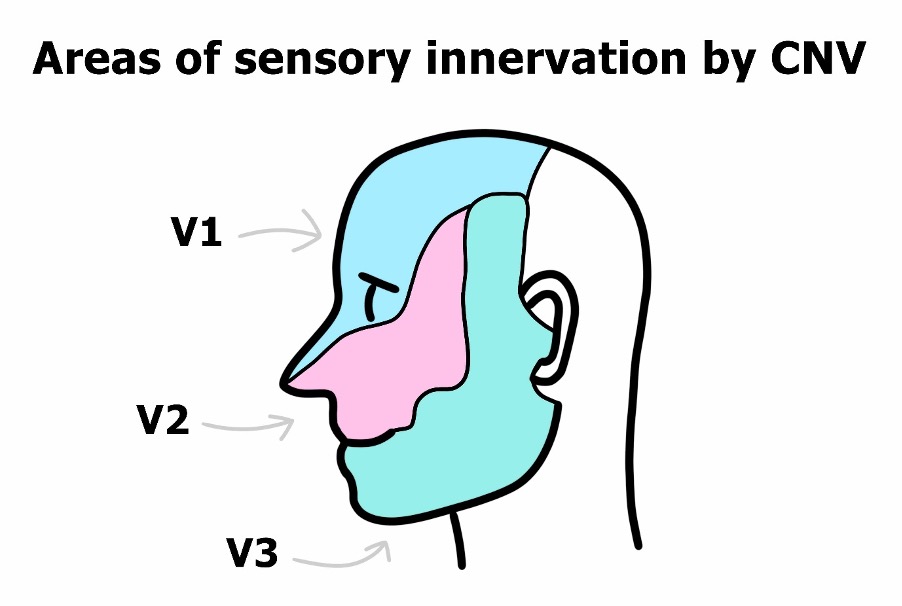
- The trigeminal nerve deals with a large proportion of nociception for the face and oral cavity.
- It consists of three branches (V1 V2, and V3). Each of these branches detects sensory information in slightly different areas.
- If you consider the pain pathways, they indicate that the nerve first synapses in the dorsal horn of the spinal cord, before travelling up to the brain.
- The nociceptive fibres of the trigeminal nerve do not synapse in the spinal cord, they synapse directly in the brainstem (medulla), but the principle is the same.
Nociceptive pathways of the trigeminal nerve
- The nociceptive neurons of the ascending pathway travel from the periphery, through the trigeminal ganglion to the medulla. Remember, these are transmitting pain signals.
- In the medulla they synapse in the spinal nucleus of the trigeminal nerve. This area is similar to the dorsal horn of the spinal cord, and some consider it an extension. (3,7)
- The neurons then ascend via the ventral trigeminothalamic tract to the thalamus, where the neurons synapse again, before heading to various areas in the cortex. (3,7)
- Note: These areas within the cortex include areas involved with emotions (limbic structures) as well as areas that can stimulate the sympathetic nervous system (hypothalamus). You will recognise that these areas explain how we react to a painful stimulus.
- The neurons in this pathway are modulated by in the brainstem by descending neurons from various local areas, as well as from the cortex. (8)
Transmitters involved in nociception
For completeness this is a list of the main mediators involved in pain transmission (not exhaustive).
Ascending pathway
- Substance P:
- In the periphery: acts as a vasodilator.
- In the neural pain pathways: A mediator involved in the synaptic transmission of the pain signal between neurons.
- Calcitonin gene-related peptide (CGRP):
- In the periphery: acts as a vasodilator.
- In the neural pain pathways: A mediator involved in the synaptic transmission of the pain signal between neurons.
- Glutamate:
- A neurotransmitter involved in the synaptic transmission of the pain signal (usually found in excitatory pathways).
Remember: All the neurons in this pathway are trying to transmit the pain signal to the brain.
Descending pathway
- GABA:
- A neurotransmitter involved in synaptic transmission (usually found in inhibitory pathways).
- Noradrenaline:
- A neurotransmitter involved in synaptic transmission.
- Serotonin (5-HT):
- A neurotransmitter with multiple functions within the body.
- Enkaphalins and Endorphins:
- Endogenous opioid-like molecules which are thought to regulate the body’s natural response to pain by acting on the opioid receptors.
Remember: The neurons in this pathway are trying to decrease the transmission of the pain signal by inhibiting the ascending pathways.
Pain Sensitisation
Neurons involved in pain perception can become hypersensitive to pain stimulation. This is caused by a decrease in the action potential threshold of the neuron, as well as an increase in responsiveness to stimulation.
- Some studies suggest that higher levels of CGRP may be involved in sensitisation of the neuron, and so an increased response to pain. (9) This may be particularly important in chronic inflammatory conditions and may be a reason why some patients seem to experience heightened dental pain compared to others.
- Higher levels of substance P have been found in the neurons of the dental pulp and positively correlate with dental pain. The evidence is still unclear as to whether substance P is involved in pain sensitisation. (10,11)
Opioid receptors (2,12)
- These are present throughout in the body, but only produce an analgesic effect when activated in certain locations. Some opioid receptors are found in the periphery.
- The opioid receptors involved in analgesia are found within certain areas of the pain pathways.
- There are different subtypes of opioid receptors, and all produce slightly different physiological effects when bound.
- Opioid receptors are G-protein coupled receptors (we will cover these in a “Receptor” lesson)
- The table below shows the various subtypes of opioid receptor, as well as the locations where activation produces analgesia.
Mechanism of action of opioid drugs (2)
Opioids are thought to act in two major ways when it comes to analgesia: (2,13)
Decrease the excitability of the neurons in the ascending pathway – particularly in the dorsal horn of the spinal cord.
- Activate presynaptic opioid receptors of neurons in the ascending pathway:Inhibits neurotransmitter release and therefore inhibit transmission of signal.
- Activate postsynaptic opioid receptors of neurons in the ascending pathway:Having a downstream effect of causing the voltage-gated, inwardly-rectifying K+ channels to open. This allows K+ to move out of the post synaptic neuron, hyperpolarising it and reducing the likelihood of it firing. Reduces inward currents of Ca2+ to the post synaptic neuron, hyperpolarising it, and reducing the likelihood of it firing. (14)
Increase the effects of the descending inhibitory pathways - via a complex mechanism, see reference for more detail (13)
Side effects (15)
Activation of opioid receptors also causes other effects, not just analgesia. Major side effects include:
- Nausea and vomiting
- Dental relevance: Erosion of teeth.
- Dry mouth and/or taste disturbances (16)
- Dental relevance: Increased risk of caries.
- Respiratory depression
- This is a very serious side effect and can result in death.
- Activation of mu and kappa receptors in the respiratory centre decreases the sensitivity of the body to changes in the concentration of CO2 in the blood.
- Activation of mu receptors also inhibits the reflex which increases the breathing rate in order to exhale the excess CO2. If the respiratory rate slows significantly it is life threatening. (2)
- Pruritus (itchy sensation)
- Administration of opioids also causes histamine release, a chemical mediator that, amongst other effects, can cause an itchy sensation. (17)
- Constricted pupils
- Opioids act to excite the accessory oculomotor nucleus (part of the oculomotor cranial nerve) which leads to contraction of the ciliary muscles in the iris, and therefore constriction of the pupil. (18)
- Constipation
- Activation of mu receptors in the GI tract decreases motility – this is utilised via the drug loperamide, which acts peripherally and does not cross the BBB. (2)
- Euphoria
- Activation of mu receptors leads to dopamine release, creating a feeling of wellbeing. (14)
- Tolerance
- Desensitisation of the opioid receptors means that a larger dose is required to produce the same response.
- Dependence (addiction)
- Prolonged administration of opioid drugs leads to physical dependence. In dependent users there are negative emotional or physical symptoms on cessation of the drug, such as:
- Craving for the opioid drug
Cautions (15)
- It would be inappropriate to prescribe opioids to patients who have a history of drug misuse – liaise with GP.
- Elderly patients may be more sensitive to the effects of opioids.
- Rapid and ultra-rapid metabolisers of codeine may be more sensitive to its effects (see “Pharmacokinetics” lesson).
- Dose many need to be reduced in renal impairment.
Interactions (15)
- Opioids interact with non-selective monoamine oxidase inhibitors (MAOIs) – no concomitant use.
- Examples of non-selective MAOIs: Phenelzine, isocarboxazid and tranylcypromine.
- Opioids and benzodiazepines can cause increased CNS depression – not recommended, liaise with GP.
Opioid Overdose
- An overdose of opioid drugs can lead to fatal respiratory depression, as previously mentioned.
- This is treated with naloxone, an opioid receptor antagonist which displaces the opioid drug (agonist) from the opioid receptors, reversing the effects.
- Naloxone has a short half-life so repeated doses may be necessary.
Opioids In Dentistry
What opioid analgesic drugs can dentists can prescribe?
(For the most up to date information always check the DPF in the BNF)
NHS:
- The only opioid drug that dentists can prescribe on an NHS prescription is dihydrocodeine* (15)
Private:
- Dentists can prescribe any drug within their competence on a private prescription (as long as it is in the BNF).
- However, remember the GDC states “you must only prescribe medicines to meet the identified dental needs of your patients” (19)
- Pharmacists will query unusual prescriptions from prescribers and may challenge or refuse to dispense prescriptions they believe are outside of the scope of the GDC guidance – this would include unusual prescriptions for drugs commonly abused, such as opioids.
*Note: Codeine is not listed in the DPF but is sold as a combination product over the counter in pharmacies (see “Purchasing opioid painkillers from a pharmacy” section)
Prescribing opioids in dental pain
- The BNF and SDCEP guidelines do not routinely recommend prescribing opioid drugs for dental pain. NSAIDs and paracetamol are usually more effective. (15,20)
- If opioids are deemed appropriate, they should only prescribed as a short course.
- Be aware of drug seeking behaviours.
- Sometimes you may see reference to the WHO pain ladder in clinical guidelines. (21) This tool was developed for the management of cancer pain but may be useful to demonstrate how pain can be treated in a stepwise manner. Please see the reference for a link to the website.
Purchasing opioid painkillers from a pharmacy
Sometimes patients may ask about purchasing opioid painkillers from a pharmacy. Here are just a few things to think about when giving advice:
- Opioids can be used alongside paracetamol and NSAIDs for pain management.
- Whilst codeine cannot be prescribed by dentists on an NHS form, it is something that can be recommended for patients to purchase.
- Combination products containing low doses of codeine combined with paracetamol (Co-codamol), aspirin, or ibuprofen, are available as P-meds from pharmacies. But only for short term use (no longer than 3 days). (22)
- Low dose dihydrocodeine combination products can also be purchased from pharmacies, with the same restrictions.
- However – the BNF states that there is little evidence to show that low dose combination products containing opioids provide any more analgesic relief than the dose of the non-opioid alone. In addition to this it states that opioid painkillers are relatively ineffective in dental pain, and instead recommends the use of NSAIDs and paracetamol as first line treatments. (15)
- Treatment recommendations for patients must be evidence based and the risk/benefit ratio assessed before recommendations are made.