Anterior incisal edges should be parallel with lower lip – This is termed Consonant.
Upper centrals and canine tips at same level. U2s 1mm shorter incisally.
U1s width = 80% of their height
Lip elevation mean = 7-8mm
Full Buccal corridors.
Treatment Principles
Treatment Timing:
Usually Early Permanent Dentition to incorporate majority of teeth.
Dependent on patient compliance
Favourability of growth may be needed. eg. Class 2 malocclusions (keep reading!)
Timing is crucial in interceptive orthodontics.
Using Leeway space for alignment will rely on timing of eruption.
Lower Arch: Dictates treatment
Lower Incisors:
Look at muscular balance and lip pressure and support. If these are not involved in treatment planning, relapse of malocclusions can occur after treatment.
Rule exceptions:
Releasing Lip Traps
Inclination caused by Habit
Deep Over bite causing incisal trapping (Class II Div II)
Class III with an adequate overbite
Receiving orthognathic surgery – New muscular balance achieved.
Extract or Not? - this depends on space and anchorage requirements.
Skeletal Limitations:
Dentoalveolar camouflaging
This involves leaving the jaw relationship (skeletal pattern) as it is, and moving the teeth to the correct occlusion to mask the jaws.
Favourable Growth
Surgical Options
Types of Appliance to use:
What tooth movements are required for treatment?
Retention:
Long Term success and prevention of relapse – in particular the lower incisors
Fixed or removable retainers.
Treatment means
Use of appliances
Ways to create space:
Using the Leeway Space
*Leeway space = this is the difference in the width of C-D-E in the primary dentition, and 3-4-5 in the permanent. The total width of C-D-E is larger than the total width of 3-4-5, hence leaving some room for movement.
Maxillary molars can move distally can gain 6-7mm in the correct environment (however may require headgear).
Expand the arch: there are variations in favourable growth in patients.
Advance incisors (must be favourable stability in long term)
Interproximal Reduction: Usually more in adults (tooth pulp retreated more). Common in lower labial areas and can create up to 3mm of space.
Extractions: Take out the poor prognosis teeth first even if it means more complex orthodontic treatment afterwards.
Extraction patterns can vary: Class II common: U4s and L5s Class III common: U5s and L4s
Benefits of Orthodontic treatment:
Psychological
Consider the dental appearance of child and their experience at school, both with teachers and pupils.
Self-esteem can be low in some orthodontic patients- keep in mind that they may experience bullying.
Dental Health
Increased Trauma Risk with an Increased Overjet:
6mm + – twice as likely to experience dental trauma (1)
Prevent Mandibular Displacements
Reduce Overbite, alleviating trauma to S/T or Dental Hard Tissues
Reduce Complications associated with impacted teeth e.g. Root resorption of adjacent teeth
May reduce caries risk as well aligned teeth are more accessible to OHI.
Function
Improve Masticatory efficiency
Eliminate adaptive swallow
May: reduce TMD and May help improve speech
Risks/Problems associated with orthodontics
Pain: Adjusting arch wire or fitting separators.
Localised inflammation around the tooth socket
Starts with hours and worsens over 24hr (2)
Decrease after 5-7 days
Tooth Mobility: Disruption and stretching of the PDL
Exacerbated by premature contacts
If becomes severe, take PA to rule out root resorption +/- bone loss
Mucosal Trauma:
From wires – Use Ortho wax
Hyperplastic mucosal reactions
Bracket Debonding: Must see Orthodontist immediately to limit unwanted movement and delaying Tx
E/O:
Flattening of profile
TMJD
I/O:
Enamel
Decalcification
fracture
Cementum
Root resorption
Periodontium
Gingivitis
Pulp
Loss of vitality
Mucosa
Ulceration
Different Types of Appliances
It is important to know the different types of appliances, even if we aren't prescribing them. In order to answer a concerned parent and patient's questions, you'll need to know the following:
Removable Appliances
These can be Active or Passive.
Uses
Move a few teeth by TIPPING
Less control over movement than fixed
Upper Removable Appliance:
Cross-bite correction (in mixed dentition)
Provide bite planes for OB reduction
Retentive components – these hold the appliance in the mouth:
Baseplate – holds everything together and can have bite-planes if required
Made of acrylic
Aligners eg invisalign
Retainers
Instructions
Full-time wear
Remove to clean or for sports
Initially speech will be affected but will improve
Increases saliva production
Review in 2 weeks to check adaptation
Review in 4 weeks for reactivation of springs
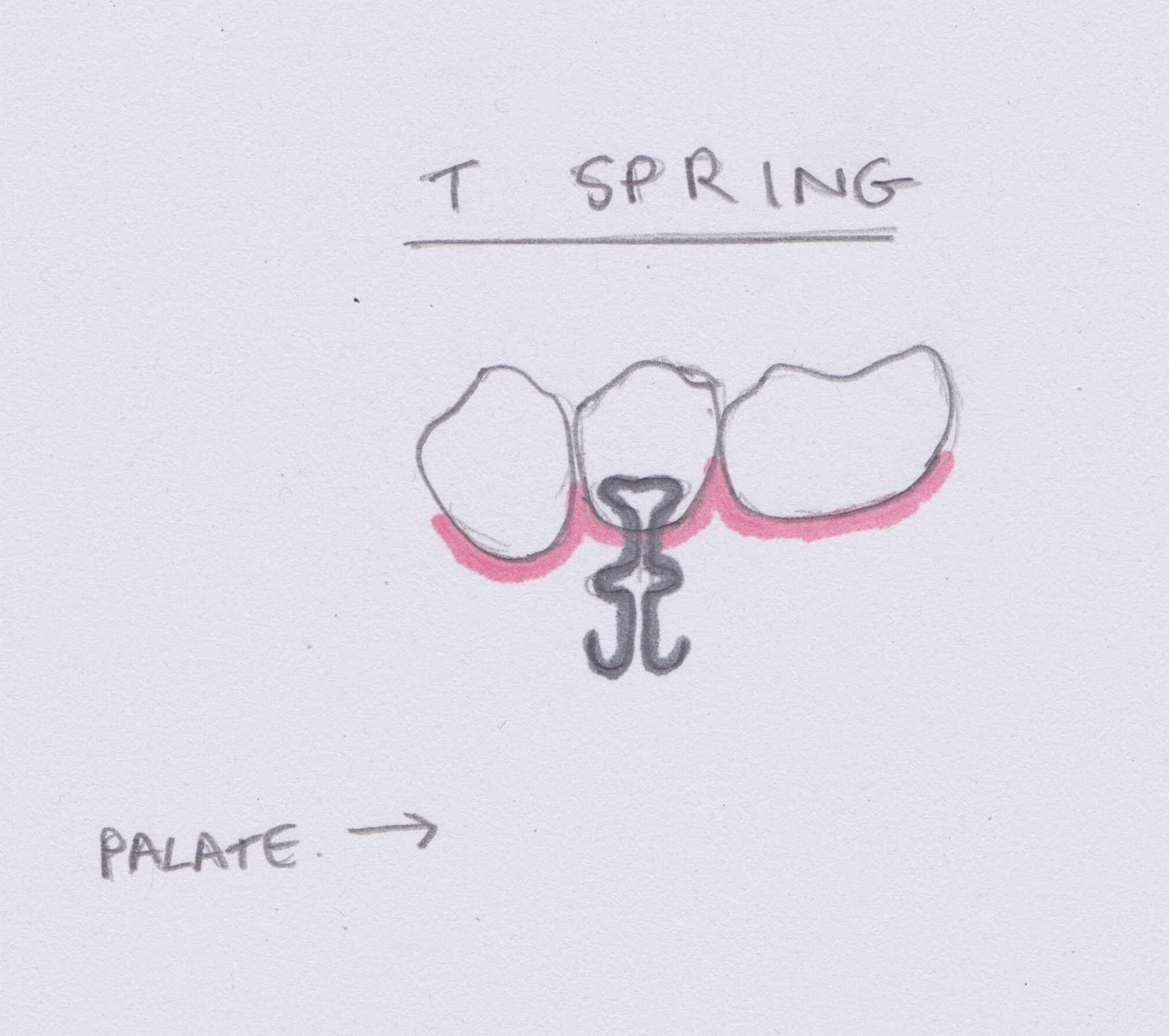
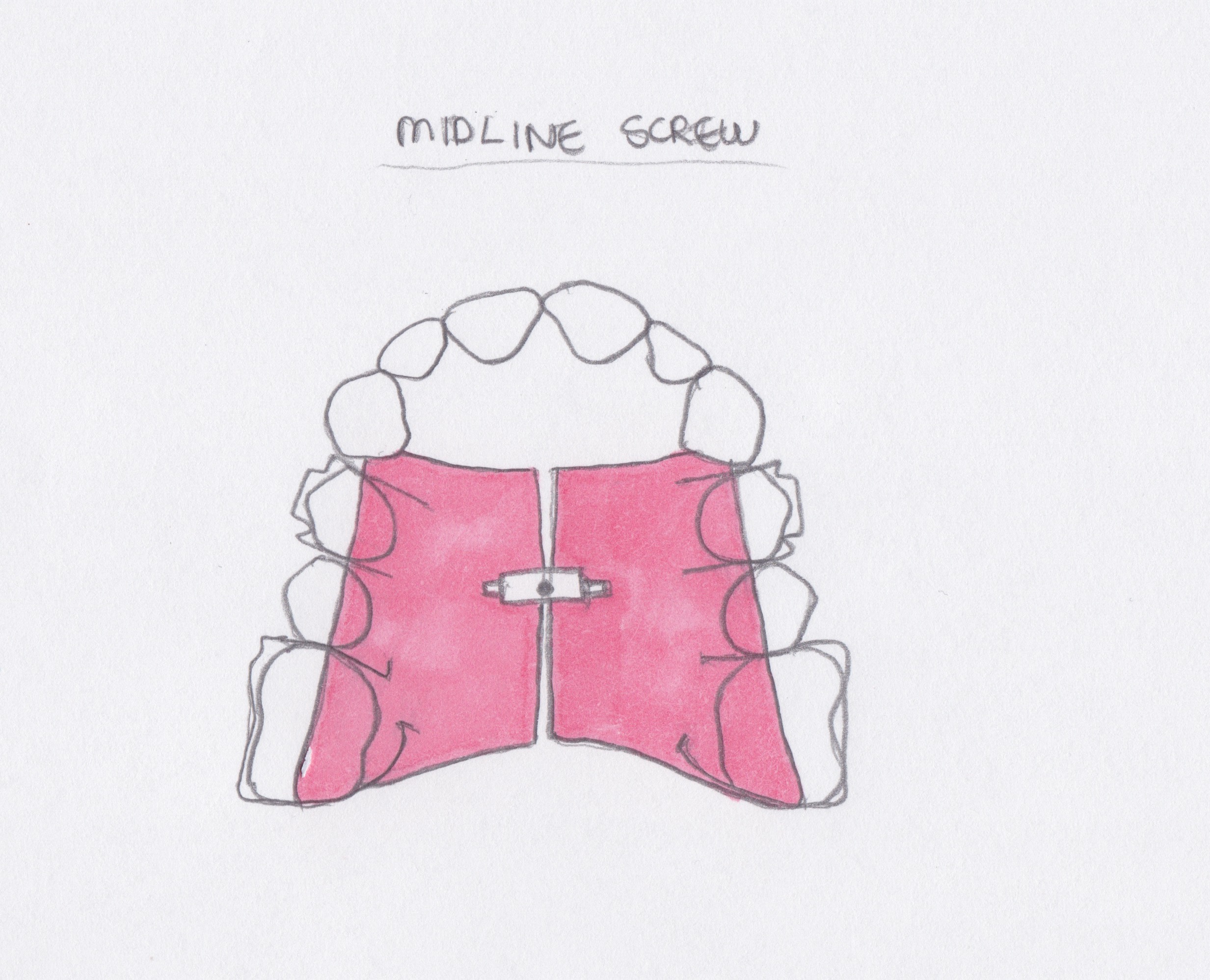
Diagrams showing the different types of Removable Appliances, with their respective active and retentive components.
Functional Appliances
These favour/utilise mandibular growth in Class II malocclusions.
Can be removable or fixed
Removable more common
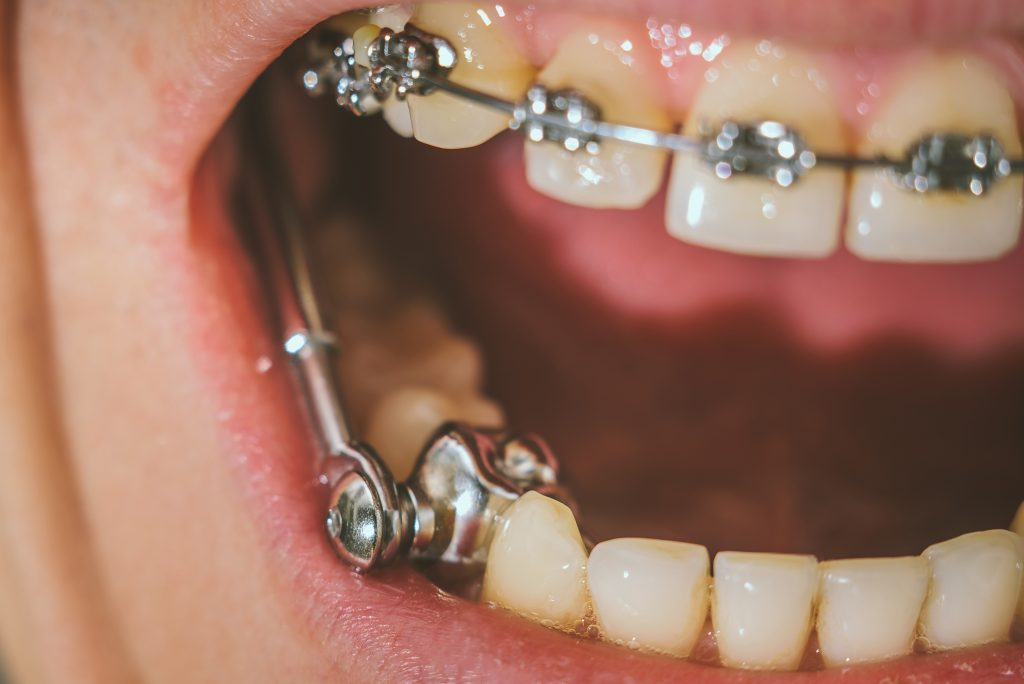
Fixed = Herbst Appliance
Image of a Herbst Appliance
Twin Blocks
Consist of bite blocks to posture the mandible forwards – blocks only fit in one position (45-70 degrees)
Worn full time
MD = adams clasps on molars and blocks on premolars
MX = acyrlic base plate with midline expansion screw, bite blocks cover molars and premolars
May have labial bow
How they work
Mostly movement of teeth
Evidence behind mandibular growth is questionable, but general consensus is that these appliances take advantage of favourable manidbular growth
Timing is key- growth spurts/puberty: M = 12-14yrs, F= 10-12yrs
Posture and stretch
Class II intermaxillary traction
OJ correction: dental 70%, skeletal 30%
Retrocline upper incisors and procline lower incisors
Molar eruption and reduce any deep overbite
Diagram of a Twin Block Appliance.
Functional regulator II:
Rolf Frankel
S/T and facial growth
Remove the restrictive forces the S/T are applying
Mixed dentition: mucosal born and therefore loss of teeth doesn’t affect retention
Buccal shield: expansion occurs due to unopposed tongue forces.
Labial Pad: works against a hyperactive mentalis
Lingual Pad: Avoidance reflex created.
Bionator
Lingual Horseshoe with Molar Facets: Acrylic design and made to posture the mandible and guide molar eruption.
Labial Bow: acts as a buccal shield as it extends anteriorly
Numerous designs: Overbite dependent
Fixed Appliances
These are commonly referred to as 'train-tracks'.
Move multiple teeth by bodily movement
Can use for intrusion, extrusion, rotation, space closure and overbite reduction.
Components
Brackets
Slots are at specific angles. Therefore, must be placed accurately in the centre of the crown and parallel to the long axis.
Can be bonded via acid-etch technique OR/ if welded onto bands they can be cemented using GIC
SS or Ceramic
Archwires
Application of active forces on teeth.
Rectangular wire in bracket slot determines tooth movement
NiTi or SS
Round/Rectangular
Auxillary components
Springs
Elastics – hold wire in place on bracket (6s tend to be used as anchorage)
Can be used from
L6-U3: class II
U6 –L3: class III
Note: Class III malocclusions are often made worse by growth so make sure these are referred early for any fixed appliance intervention.
Stages:
Diagnosis and Treatment Plan
Anchorage Control
Levelling - Bracket slots in the level in the Vertical Plane
Aligning – Correct Rotations, Tip and Inclinations. Using Flexible wires.
Flexible round wires used initially to align
Stiff rectangular wires used as teeth become straighter – correcting inclinations, Levelling the curve of Spee, and Space closure (rigid guide for bodily movement).
(Finishing dimensions of the wire usually SS wire: 0.019 x 0.025inch)
Reduce Overbite: Before Incisors can be placed into Class I (to reduce the risk of a traumatic anterior bite)
Correct Overjet: Large rectangular wires.
Space closure: Large rectangular wires. Inter and intramaxillary traction can be applied to help close spaces.
Finishing Adjustments -Centre Lines & Occlusal settling using intermaxillary elastics . Final Tip adjustments and inclination can be carried out. Bending of wires into certain positions can be used, or adjusting slightly out of place brackets.
Stability: Long term (removable or fixed).
Diagram of a Fixed Appliance and its components.
Headgear
Delivers movement from outside mouth – not commonly used anymore.
Reverse headgear = used to be used in class III malocclusions.
Can be attached to a Kloehn Facebow.
Others:
Temporary anchorage devices (TADs): mini-screws inserted intra-orally into bone and used as anchorage points.
Transpalatal Arch – 0.9mm SS wire attached to molar band –used to stabilise molars
Quadhelix – used for maxillary arch expansion/crossbite correction
0.9mm SS
Diagram of a Quadhelix Appliance.
Orthognathic surgery
Orthognathic surgery involves moving the jaws into a favourable position due to large skeletal discrepancies.
The patient is given pre-op. and post-op. braces to then align the teeth once the jaws are in place.
There are different types of orthognathic surgery, depending on what type of malocclusion is present.
It can typically be used in:
severe Class II cases to bring the mandible forward.
Severe Class III cases to bring the mandible back or maxilla forward.
There are more types than this, however see BOSfor more details as to the different types of surgery.
Surgery can involve the mandibular nerve so anatomy knowledge for this is paramount.
Conclusion
The 3 main types of orthodontic appliances are removable, functional and fixed. You should now know these in some depth as well as considering the broader parts of orthodontic treatment planning.