
This lesson will define pharmacodynamics, explain the different targets for drugs (including receptors), then finally, discuss adverse drug effects and their classifications.
This is an area of pharmacology that is often defined as “what the drug does to the body”. It is a subject concerned with both the therapeutic, and adverse effects of a drug on the body systems.
To be considered active, a drug must bind to a target and induce/ block a change/ response. There are many targets that a drug can bind to, the main ones being: (1)
We will look at each of these targets in turn, linking a dentally relevant example where possible. Specific targets/ receptors will be covered in various pharmacology lessons, this lesson is designed to be something you can refer to and help you visualise what is happening when a drug acts on a target.
These are pores in the cell membrane that allow ions to diffuse down their concentration gradient.
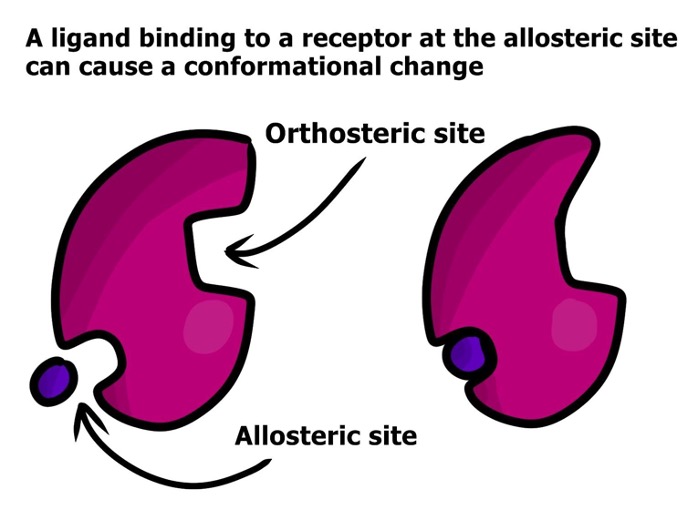
Example:GABA-A receptors are ligand-gated ion channels. GABA (a neurotransmitter) is the primary ligand and can bind to one of two main binding sites, activating the receptor. Benzodiazepines bind to a separate allosteric binding site, acting as a positive modulator for the ion channel. (2)
Example: Local anaesthetics such as lidocaine physically block voltage gated Na+channels.

Receptors can be a broad term in pharmacology, but in here we will use it to mean a particular binding site on a protein. Often receptors are linked to other proteins or channels in such a way that activation of the receptor causes a change in the associated molecule.

In brief, the main point of a G-protein coupled receptor is to transmit a message from the receptor itself, to effector enzymes or proteins within the cell. This message then brings about a change, whether it is excitatory or inhibitory.
Note: To prevent the risk of delving too deeply into cell signalling pathways (they are very complex!) we will just name two G-protein coupled receptors pathways, but for more information on the specifics, please see the references (1).
Two examples of transmission pathways that are affected by G-protein coupled receptors:
These receptors are the most common drug targets in the human body, and so throughout the pharmacology lessons we will encounter many drugs that exert their effects via this route. (1)
Found inside the cell, there are two classes:
Example: Hydrocortisone (a corticosteroid) binds to nuclear receptors in the cytoplasm of the cell. This complex then travels to the nucleus and inhibits the transcription of certain pro-inflammatory interleukins and cytokines. See “Corticosteroids” lesson for more information.
Enzymes can work as drug targets in multiple ways, some examples are listed below:
Example: Penicillin inhibits the transpeptidase enzyme in bacteria, preventing peptidoglycan cross linkage, which is a stage involved in bacteria cell wall synthesis. The inhibition of this enzyme is bactericidal. (1)
Example: Codeine is converted to morphine in the body by host CYP450 2D6 enzymes.
Example: Metronidazole is an antibiotic prodrug which is activated by bacterial enzymes. (4)

Example: Mercaptopurine (a drug used to treat some cancers and autoimmune conditions) is thought to outcompete endogenous purines for incorporation into DNA and RNA, the result of which is cytotoxic. (1,5)
Example: Proton-pump inhibitors, such as omeprazole and lansoprazole, block the H+/K+- ATPase transporter which is responsible for pumping H+ ions into the stomach to maintain an acidic environment. The reduced acidity of the stomach acid results in decreased reflux symptoms. (6)
Now we have covered how a drug can act on the body, it is quite simple to see how a drug can cause adverse effects. Drugs are specific to certain targets, but these targets are often found in multiple places in the body. The action of the drug on a target in the wrong site is sometimes the cause of these side effects. In addition, as drugs often affect a signalling cascade (such as when they act on G-protein coupled receptors), many downstream processes are also affected. We can alter the formulation of the drug to try and minimise these side effects, but it is not always avoidable.
This term specifically describes a reaction that occurs after administration of a drug, which is harmful or undesired. These can range from mild reactions, such as a minor rash, right up to severe reactions which can be fatal. Often the reactions are categorised into the following groups:
Example: An excess dose of warfarin causing bleeding.
Example: Dry mouth associated with antidepressant medication.
Example: Anaphylaxis after antibiotic administration.
Example: Osteonecrosis of the jaw associated with bisphosphonate use.
Example: Carcinogenesis following treatment with certain anticancer drugs.
Example: Anxiety after withdrawal of benzodiazepines.
This is a way of reporting adverse drug effects to the Medicines and Healthcare products Regulatory Authority (MHRA). This is so they can monitor the frequency of side effects, and update product literature as more information is complied. Healthcare professionals should report:
You can report online, or via a mobile app, see the guidance for more information. (7)
Drugs act on a variety of targets, of which there are multiple types. This lesson has covered the basics of these receptors and provided you with a foundation for the other lessons within this topic.
Adverse drug reactions can be classified into different groups, and certain adverse drug reactions should be reported to the MHRA.
1. Ritter J, Flower R, Henderson G, Loke YK, MacEwan D, Rang HP. Rang & Dale’s Pharmacology, Ninth Edition - ClinicalKey Student [Internet]. 9th Edition. Elsevier; 2020 [cited 2020 May 28]. Available
2. Griffin CE, Kaye AM, Bueno FR, Kaye AD. Benzodiazepine Pharmacology and Central Nervous System–Mediated Effects. Ochsner J [Internet]. 2013 [cited 2020 Jul 13];13(2):214–23. Available
3. Sever R, Glass CK. Signaling by Nuclear Receptors. Cold Spring Harb Perspect Biol [Internet]. 2013 Mar [cited 2020 Jul 14];5(3). Available
4. Sisson G, Jeong J-Y, Goodwin A, Bryden L, Rossler N, Lim-Morrison S, et al. Metronidazole Activation Is Mutagenic and Causes DNA Fragmentation in Helicobacter pylori and in Escherichia coli Containing a Cloned H. pylori rdxA+ (Nitroreductase) Gene. J Bacteriol [Internet]. 2000 Sep [cited 2020 Jul 14];182(18):5091–6. Available
5. Nelson JA, Carpenter JW, Rose LM, Adamson DJ. Mechanisms of action of 6-thioguanine, 6-mercaptopurine, and 8-azaguanine. Cancer Res. 1975 Oct;35(10):2872–8.
6. Shin JM, Sachs G. Pharmacology of Proton Pump Inhibitors. Curr Gastroenterol Rep [Internet]. 2008 Dec [cited 2020 Jul 13];10(6):528–34. Available
7. Adverse drug reactions - NICE CKS [Internet]. [cited 2020 Jul 14]. Available
8. Farcas A, Bojita M. Adverse Drug Reactions in Clinical Practice: a Causality Assessment of a Case of Drug-Induced Pancreatitis. J Gastrointestin Liver Dis [Internet]. 18(3):353–8. Available