
Composite Resins are continuously being developed, but they still aren't perfect. This lesson will take you through the composition of the material and the clinical applications.
We are always told that using composite resin is "technique sensitive," but why is this?
Resin composites dislike water, shrink, and can require many stages to be carried out. Its amazing that they work, because the mouth is wet, we need a strong tooth-restoration interface, and are continuously under time pressure. The development that has occurred in this area of dentistry is targeted to combat each one of the problems just mentioned.
In addition to the above list, composites require curing (chemical or light) stabilisers, inhibitors and initiators. These materials prevent oxidation occurring which would impact on the stability of the shade and accelerate the reaction needed to form adequate functional properties.
Composites can be classified due to their resin structure or the filler particle, which can vary in both material type and particle size. How the reaction occurs and sets can also categorise composite resin into, chemical cure, light cure or dual cure.
This field is huge, so I will do my best to give you the essentials and please see the recommended reading if you wish to delve further.
Resin is basically two reactive methacrylate groups joined together by an aromatic backbone. These monomers when activated will form longer chains to create the matrix via the process of polymerisation.
The common monomers you will cross are BisGMA (Bowen's Resin), UDMA and TEGDMA. The first two monomers are highly viscous so would be too hard to manipulate and work with on clinic. The third listed here is much lower in molecular weight so improves the handling ability of the composite. These constituents can influence the properties of the composite but it is the filler constituents that have the greatest impact on clinical capabilities.
The filler has many impacts:The overall restoration will incorporate the material principles of the filler e.g. brittleness. The filler's main rolls are to:
Glass: More detail concerning glass will be highlighted in the ceramics lesson of this topic module. The glass used in Resin composites are mainly Quartz or Silica. Glass is basically an amorphous solid which means it is non-crystalline. It is denser than the resin 4x fold, providing optic properties and strength. Quartz provide a much harder material than Silica but is more difficult to finish the surface. Other glass constituents do exist such as colloidal silicas and fluoride salts.
Ceramics: When dealing with Composite Resins these are Zirconia based. This material is inorganic, non metallic and can be very strong.
The main principle here is surface area. Gaining the optimal particle load for adequate strength, but not over saturate the resin as to lose continuity of the matrix. The size of the particle will have its own properties and generally speaking the bigger the stronger, but, this then has to be balanced with aesthetic considerations.
As mentioned before there is a fine balance to the filler; being able to utilise the particle properties, whilst maintaining full structural integrity in the matrix, obtain good handling skills and a pleasing finished result. Using the Hybrid filler as an example, having 86% weight filler which equates to roughly 70% volume appears to provide this balance.
Note: How does weight not equal volume? This is due to the density. You need less of a material which is dense to make up the majority of the weight.

Silane agents are bifunctional, meaning they have the ability to react with both the inorganic hydrophilic filler and the organic hydrophobic resin. These reactions are acid activated. Without a coupling agent the composite simply wouldn't work, but it is because of this that we need meticulous moisture control. The reactions that occur during setting are very susceptible to water degradation. Once set, these bonds need to be strong to resist creep, endure occlusion load, preventing crack propagation.
Chemical Cure:
This is usually a base-catalyst two paste system. The monomer and filler are the base and contain a tertiary amine, with the catalyst also having monomer and filler with the addition of benzoyl peroxide phthalate.
Light Cure:
The material will need a photo initiator and a inhibitor. Without the inhibitor the resin would set early. Wavelengths between 460-470nm are used to activate the composite.
Curing composites require free radical polymerisation. This usually consists of three phases:
Curing for 10seconds will set the material 85%. It takes a further 2hrs on average for the material to become fully set. Dual cure composites exist for circumstances when the clinician isn't sure if sufficient light will get to the resin, therefore provides confidence that in those areas chemical cure will initiate the set.
Resin Composite setting reaction is anaerobic. This is useful as the oxygen inhibition layer allows for the material to be layered and bond to itself. However, the final surface layer will always remain. Curing through a glycerin gel, or matrix can eliminate this layer providing a good surface finish. This layer should be removed if not prevented before polishing is carried out.
As the resin sets, it shrinks. This has improved but still exists. Shrinkage can lead to micro leakage at the restorative interface, micro-fractures within the material due to stress, marginal staining and post-op sensitivity.
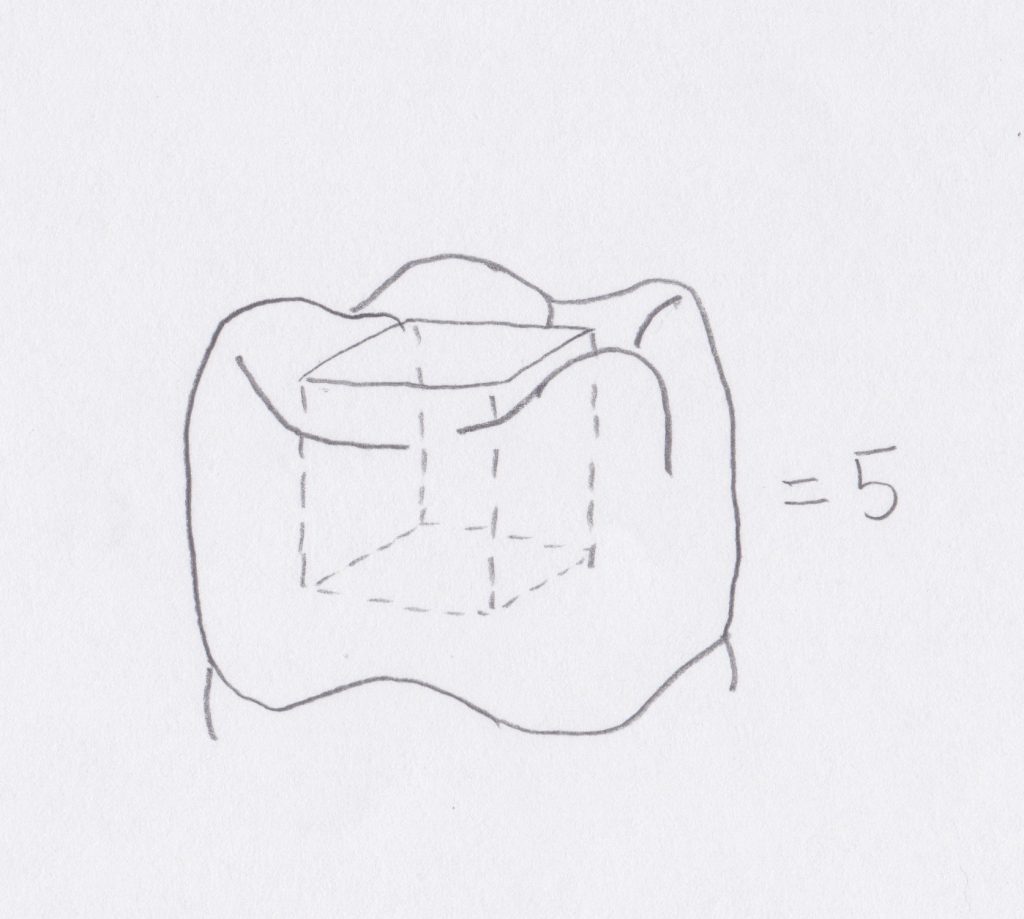
This is simply how the stress of the material is released when setting. It comes down to the ratio between the surface area of the bonding surfaces in relation to the exposed surface.
Example: If we were to place our composite in a Class 1 occlusal cavity and push it up against all four walls and the cavity floor, we have created a huge bonding surface area with only one exposed surface. This is a high ratio and therefore creates high stress through the material. If we took the same cavity and placed the composite against one wall and the floor we have now decreased the ratio dramatically and stress can be distributed more evenly on cure. Therefore, smaller cavities, which are bulk filled will show a higher C-factor and greater stress at the tooth-restorative interface.
In addition, when curing the composite, it will shrink towards its centre of mass and towards the light. This could create a pulling effect away from the walls.
This brings us to incremental layer. This not only as mentioned, decreases the stress put through the material but also helps to combat the polymerisation shrinkage. As we build each layer it will cover the micro shrinkage of the previous. But, the final layer will show shrinkage and therefore each time we place the material we must consider the stress we are creating to minimise marginal leakage.
Incremental layer also prevents us from placing too much composite at one time. The wavelength will only pass through 2mm of the material, so if layering is too thick this could leave our restorations undermined by unset resin at the base of the cavity.
Other factors such as the rate of reaction will also effect the amount of leakage and the exothermic effects. In addition, we must also consider the quality of the tooth; is there enough strength to resist cusp flexure? If not, this will cause further stresses to occur at the restorative interface and a form of cuspal protection could be beneficial for the longevity of the tooth.
As mentioned in the material principles lesson, adhesion is the chemical affinity of two unlike constituents. Resin composites fall under the term "adhesive" dentistry, but remember an adhesive is the material that bonds (sticks) two products together. Resin does NOT chemically bond to the tooth, therefore, not true adhesion. The mechanism used is mirco-mechanical retention with the use of the bonding adhesive, in the etch, prime and bond method.
Therefore, the etch, usually 37% phosphoric acid, increases the surface area of the enamel (producing tags), and removes the smear layer we have created during cavity preparation (a layer of debris). The primer then displaces surface moisture (particularly in dentine) whilst supports the collagen fibres; this allows the bond to have good wettability and infiltrate these surfaces. Once cured, we now have a controlled surface to incrementally layer our resin onto. Hybridisation occurs over the dentine surface as the resin is incorporated into the collagen matrix. This leaves behind what we know as the Hybrid layer and in some books dentine bonding is referred to as "wet bonding".
Bonding methods will be covered in more detail in the cement and bonding lesson.

We also don't want premature setting to occur before placing intra-orally. The orange caps and dimmers must be used as the photo inhibitors will only cope with so much. Premature set will result in a decrease in the material wettability and therefore decrease surface contact and bond strength.
Moisture control has previously been mentioned, but without it (gold standard rubber dam) we are setting ourselves up for failure. If contamination occurs on placement the reaction will be ineffective and setting impaired leading to inadequate material properties.
The water paradox. Once set, the hydrophobic resin properties are no longer as concerning. The hydrophilic properties of the filler now take over. At the surface water sorption now occurs which will degrade our restorations over time. This will be exacerbated in areas of high load, as wear resistance decreases. If the resin quantity is high, this allows the water sorption to infiltrate further, causing hydroscopic expansion (swelling). This was thought to compensate for the polymerisation shrinkage, but unfortunately its effect isn't significant enough to do so.
We have also mentioned the reactions taking place are anaerobic causing a inhibition layer. This is also crucial when we place composite. Don't play with the material too much. Air will become entrapped and now we have inhibition within the material. This not only looks grainy, but weakens the material properties.
Be aware of the setting times by the manufacturer because polishing resin too soon can lead to dust formation and entrapment at the margin. This is because the material isn't fully set. it can take a couple of hours for the polymerisation to occur fully throughout the material. Be sure to polish with water, resin can be susceptible to heating, we must always have the pulp in mind.
The oils in eugenol can interfere with the setting reaction of resin composite. Be sure to plan accordingly, and if planning to cement, or use composite as a core, avoid eugenol containing temporary materials during the interim of lab work etc.
Repairing composite can be done, but because the material we are adding too has gone through the setting process, there is less unreacted monomer to bond. The strength of the repair is 60% of that compared to a fresh placement. This concept is relevant to lab made composites. The lab will cure and and treat the restoration more accurately to the models to eliminate shrinkage. However, there is now very little free monomer to bond and therefore, cementation can be the weakest link. Note: The resin cement will also show shrinkage at the margin.
Newer Systems:
Epocy resins have been created which contain siloxane/ oxiranes. These constituents are best described as rings. Instead of joining together monomers which shorts the material, these new resins has rings which are short, but when the reaction is initiated they open to join together, therefore decreases the shrinkage that occurs. The incorporation of fibre is also being investigated but difficulties in the fibre alignment make application more complex than the theory.
Resin has a similar coefficient of thermal expansion, therefore will mimic the tooth more so than amalgam for example.
However, the material constituents aren't completely human friendly:
Resins are complex materials, but they are now showing adequate strength properties and please the aesthetic demand of the patient. They do require time and skill, and without meticulous care taken, the restoration is more likely to fail. Bonding and the various systems will be spoken specifically in the cement and bonding lesson module.
These resources were used throughout to help produce this lesson:
Bonsor SJ, Pearson G. A clinical guide to applied dental materials. Elsevier Health Sciences; 2012 Dec 5.
Von Fraunhofer JA. Dental materials at a glance. John Wiley & Sons; 2013 May 31.
These articles should provide a great base for further reading; surrounding the field of composite resins.
Dental Update:
Burke FT, Mackenzie L, Shortall AC. Survival rates of resin composite restorations in loadbearing situations in posterior teeth. Dental Update. 2019 Jun 2;46(6):524-36.
Dental Update:
Mackenzie L, Shortall A, Burke T, Parmar D. Posterior composites: An update. Dental Update. 2019 Apr 2;46(4):323-43.
Dental Update:
Bhola S, Barker D. Composite Build-Ups: a Review of Current Techniques in Restorative Dentistry. Dental Update. 2020 Mar 2;47(3):186-98.
Dental Update:
Smithson J. Form ever follows function: the occlusal compass and direct resin composite restorations. Dental Update. 2019 Apr 2;46(4):344-50.
Dental Update:
Khalid M, Chughtai MA. Art and Science of Shade Matching. Dental Update. 2020 Mar 2;47(3):238-45.
Dental Update:
Mackenzie L. The composite issue.