
Amalgam is being phased down and in some countries it has been completed phased out. However, the material is still used throughout the UK. This section will cover the material science, usage and shortfalls of dental amalgams.
Amalgam is an alloy. The metals contained within the material have reactive surfaces, that when come into contact with mercury react to form the material we all love to pack and carve.
There are many constituents within Amalgam, and listed below are some of the more important ones we need to be aware of
Conventional amalgam's shortfalls came down to the zinc content and tin reactions. Zinc is used as an oxygen scavenger but if contaminated with saliva it reacted to form hydrogen and would expand causing restoration/ tooth failure. Tins affinity to mercury produces a highly reactive complex with a high chemical and electrical status, which leads to faster corrosion rates, increased creep and a decrease in the amalgams strength; highly detrimental to the tooth-restoration interface.
Silver-tin complexes produced relatively non-reactive cores. The addition of copper now produces a copper-tin core, which decreases the amount of the highly reactive tin-mercury content. The Amalgam produced is now a lot less reactive and has improved strength, showing less creep and corrosion. Overall micro-leakage at the restorative interface is reduced.
The way we are taught is with the chemical equation, and a classic MCQ question asks, which phase is the weakest link of Amalgam.
Gamma = Silver-Tin
Gamma 1 = Silver-Mercury
Gamma 2 = Tin-Mercury
Therefore, Copper helps to reduces the amount of Gamma 2. Further improvements can be made to the amalgams strength and its resistance to corrosion by the addition of Palladium. Indium is used to increase wetting, meaning less mercury can be incorporated and reducing the potential vapours. Zinc does still have its roll but used in finite amounts.
Conventional: Low Copper - now superseded
High Copper (Average content around 30% weight)
Alloy Shapes:
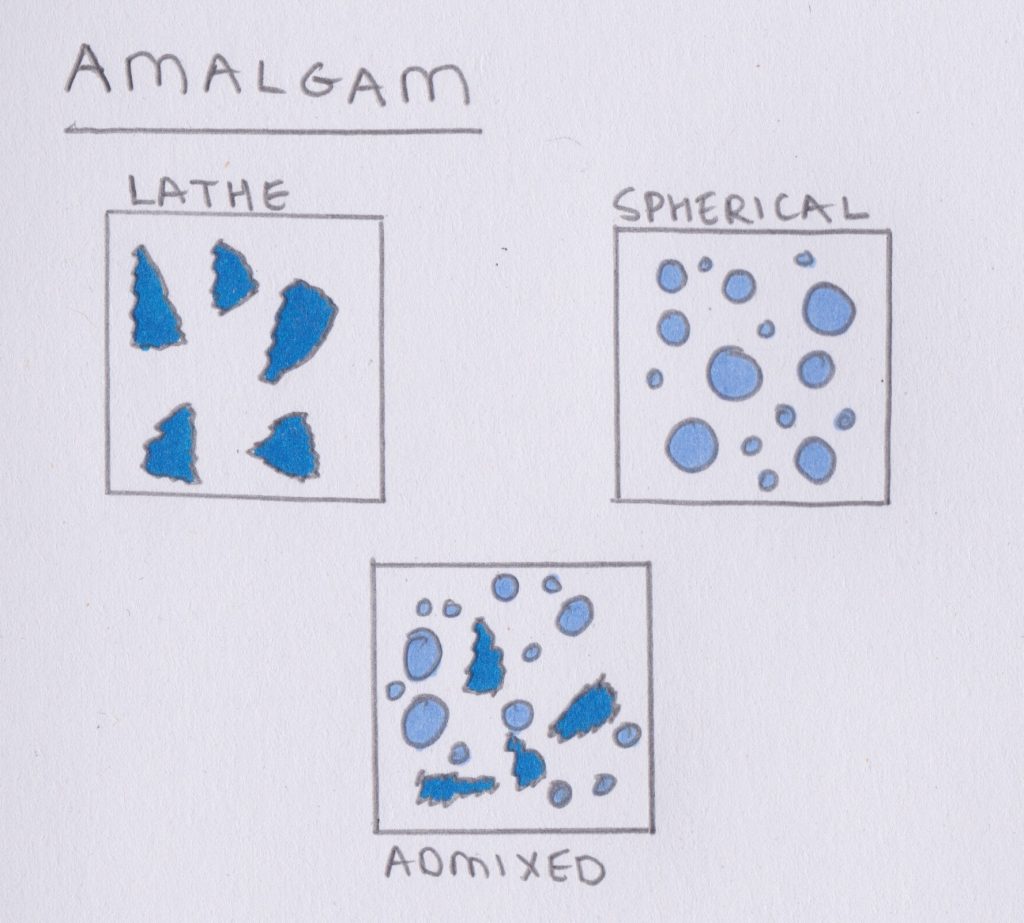
Amalgam has proven successful over decades of dentistry. It has a high compressive strength but it is still known as a brittle material, therefore is weakest against tensile forces (being pulled).
Amalgam is prone to micro-leakage, despite the efforts to improve its properties. This is due to having a greater coefficient of thermal expansion and a high diffusivity. The material changes shape more than the surrounding structure. This occurs over a number of years via cyclic/ transient thermal effects. The margins corrode and degrade and the tooth may fracture.
2mm thickness is required to provide adequate strength under areas of load due to the brittleness of the material.
Amalgam has no chemical affinity to the tooth, therefore require macro and micro- mechanical retention. Undercuts are produced with a cavo-surface angle between 70-90o to avoid unsupported enamel and keeps in accordance to the enamel prism arrangement.
When a lock is needed, the isthmus should ideally stay within 1/4 of the tooth width. With increased loss of tooth, flexure of the cusps becomes an issue and increase the likelihood of fracture. Caries when present will dictate the shape.

Leaching of the material can be useful and seen to be anti-cariogenic; however, over time the degradation weakens the material.
Polishing our amalgams is important to reduce pits in the surface (decreasing corrosion). However, due to the long residual setting time, this should be carried out on a separate appointment. In relation to the delayed set, prepping an amalgam core should also be carried out at a separate appointment, unless using a fast setting material that could show adequate dimensional stability around 10mins.
Titration:
We now use capsules which inside contain the enclosed mercury and alloy constituents. This method helps to keep proportions constant, reduce the risk of mercury spills and decrease vapour.
Ever wondered why the amalgamator sits on tin foil? If we were to spill the capsule, the aluminium reacts with the mercury making it less harmful.
Amalgam is commonly associated with:
The majority of the adverse effects are due to the corrosive breakdown of the material.
Amalgam still has its place in modern dentistry making it a key material to know about. The material will sustain occlusal loads but with time, even with the improvements made, will show degradation at the tooth-restorative interface. I hope the above helps and enjoy carving on clinic.
These resources were used throughout to help produce this lesson:
Bonsor SJ, Pearson G. A clinical guide to applied dental materials. Elsevier Health Sciences; 2012 Dec 5.
Von Fraunhofer JA. Dental materials at a glance. John Wiley & Sons; 2013 May 31.
BDA Amalgam
HTM 01-05
SDCEP- Restricting the use of Dental Amalgam
Dental Update:
Burke T. Perhaps the thumb technique wasn't so bad!. Dental Update. 2018 May 2;45(5):381-2.
Minamata:
Burke FT. Minamata: What the practising dentist needs to know. Dental Update. 2018 Jun 2;45(6):579-80.