Orthodontics at a Cellular Level

Author
Date Released
Sum
29/04/2020

This lesson aims to cover the key life science principles that apply to orthodontics.
Bone Metabolism and Turnover 

Calcium Homeostasis and Bone Turnover: 

  • Here's a fun fact: Your body goes through 7 different skeletons during your lifetime!! 
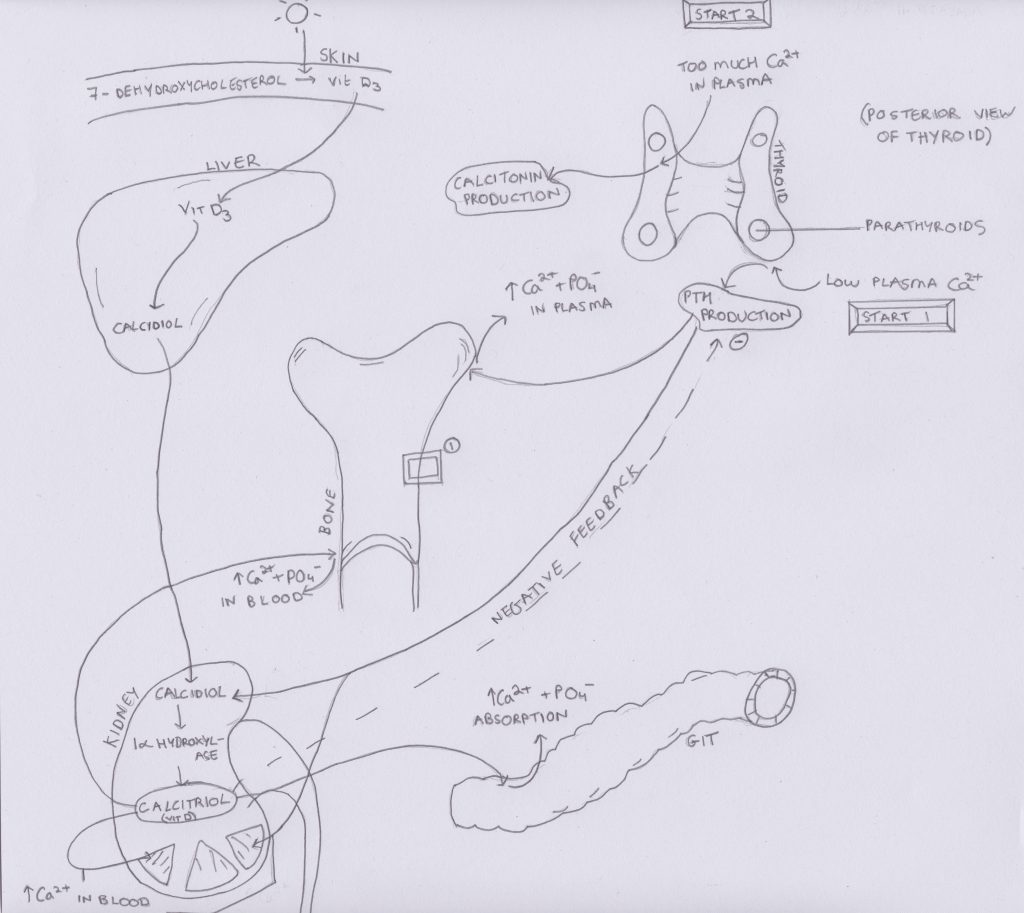
  • Involves the hormones Calcitonin and Parathyroid hormone (PTH) 
    • Calcitonin encourages calcium to be deposited into the bone 
    • Parathyroid hormone aims to balance calcium levels in the blood. Therefore, if blood calcium is low (as calcium is required for many functions in the body, eg. Nerve impulses), PTH is released.  
      • PTH release will be inhibited when blood calcium levels return to normal – like all negative feedback mechanisms  
      • PTH stimulates bone resorption so that calcium stored in the bones is released into the blood stream.  
      • It also affects Vitamin D metabolism and renal Vitamin D absorption – as shown in the diagram below.
  • Vitamin D is also involved by stimulating differentiation of osteoclasts to mobilise calcium if required.  
  • Bone is constantly being remodelled (resorbed and formed). 
  • Bone resorption is conducted by osteoclasts. 
  • Bone formation/deposition is conducted by osteoblasts. 
    • Osteocytes also sit in the bone and can differentiate to osteoclasts if need be. 
Diagram showing Calcium Homeostasis.
Note: Cholecalciferol = Vit D3, Calcidiol = 25-hydroxycholecalciferol, Cacitriol = 1,25-Dihydroxycholecalciferol (1)
Diagram showing Bone Turnover: Enlargement of section 1 above.
Note: OPG = osteoprotegerin (1)

Theories of Tooth Movement 

Basics: 

  • The PDL (periodontal ligament) consists of collagenous connective tissue, cells, blood vessels, some neurological elements (eg. Proprioceptors) and tissue fluids. 
  • The PDL functions are: tooth movement, absorbs masticatory forces, controls masticatory feedback, allows tooth eruption etc.  
  • Bone is continually being deposited and resorbed.  

Theories of Tooth Movement: 

  • The role of inflammatory mediators has been deemed important. 
  • Pressure tension theory 
    • Force applied to a tooth. This leads to bone resorption on the side under pressure whilst bone is deposited on side under tension. This leads to tooth movement.
    • Movement on pressure side is thought to be directly due to resorption. This may be due to compression of the PDL, thus obstructing the blood flow to cells in the surrounding area. 
    • This causes 'hyalinisation' of the PDL (2) – it begins to necrose.  
    • This may lead to an inflammatory response which can cause osteoclasts to start resorbing the bone – this process is called undermining resorption.  
    • *Frontal resorption in contrast, is when lighter forces are applied to the tooth and resorption occurs without compression of the PDL.  
    • Movement on the tension side may be due to PDL being stretched and therefore receiving increased blood flow. This encourages osteoblasts to deposit and mineralise bone matrix.  
    • Fibroblasts are involved in PDL remodelling, whilst cementoclasts may be activated by the inflammatory response and cause some external root resoprtion.  
  • Piezoelectric theory 
    • Bone is deflected when a force is applied to a tooth, despite PDL cushioning this.  
    • This deflection causes stress-generated action potentials in neurones at the bone surface. 
    • Not generally accepted as the deflective forces last for a short amount of time so would not cause drastic tooth movement. 
  • Cell shape change theory 
    • Believed that cell distortion on either side of the tooth (with the pressure applied to it) causes receptors to be activated and causes a sequence of events, involving cytokine release (along with other biochemicals). These then lead to bone remodelling. 

Different Types of Tooth Movement 

  • Tipping – force generally applied in a small area 
    • Point contact on crown of tooth- typically removable appliances 
  • Rotation 
  • Intrusion 
  • Extrusion 
  • Root movement/torque 
  • Bodily movement – force dissipated over a large area 
    • More difficult to control – typically fixed appliances 
    • Requires two times the force needed for tipping a tooth 

Factors affecting tooth movement 

  • Duration of force  
  • Excessive delivery of force 
    • Increases pain 
    • Increases tooth mobility 
    • Increases the risk of tooth mobility 

Biological and Mechanical Principles of Tooth Movement in Orthodontics: 

  • By applying a force to a tooth, this stimulates a response that encourages remodelling of the periodontal ligament and alveolar bone, which allows tooth movement under that force.  
  • For the tooth to move in the favourable direction, bone resorbs on the side of the tooth under pressure, and deposits bone on the opposite side – thus 'shifting' the tooth position in the bone.  
  • The periodontal ligament is thought to remodel as this process occurs. 
  • The tooth itself may experience some root resorption as a result of this movement and activity.  
  • Tooth movement will only occur once the lamina dura (cortical bone overlying the tooth socket) has resorbed- this can take 7-14 days (3).  
  • The pain associated with orthodontics is essentially derived from the inflammatory processes.  

Conclusion

This lesson has covered the main biomechanics of orthodontics.

We hope you are ready to apply this to the following lessons!

References

  1. Armando Hasudungan Youtube Video
  2. Roberts-Harry D, Sandy J. Orthodontics. Part 11: orthodontic tooth movement. British dental journal. 2004 Apr;196(7):391-4.
  3. Li Y, Jacox LA, Little SH, Ko CC. Orthodontic tooth movement: The biology and clinical implications. The Kaohsiung journal of medical sciences. 2018 Apr 1;34(4):207-14.

Signup to get the latest information on courses, lessons and special premium content.

We won't sell or give your information away to any third party, see our privacy policy here>.

    In partnership with...
    linkedin facebook pinterest youtube rss twitter instagram facebook-blank rss-blank linkedin-blank pinterest youtube twitter instagram